
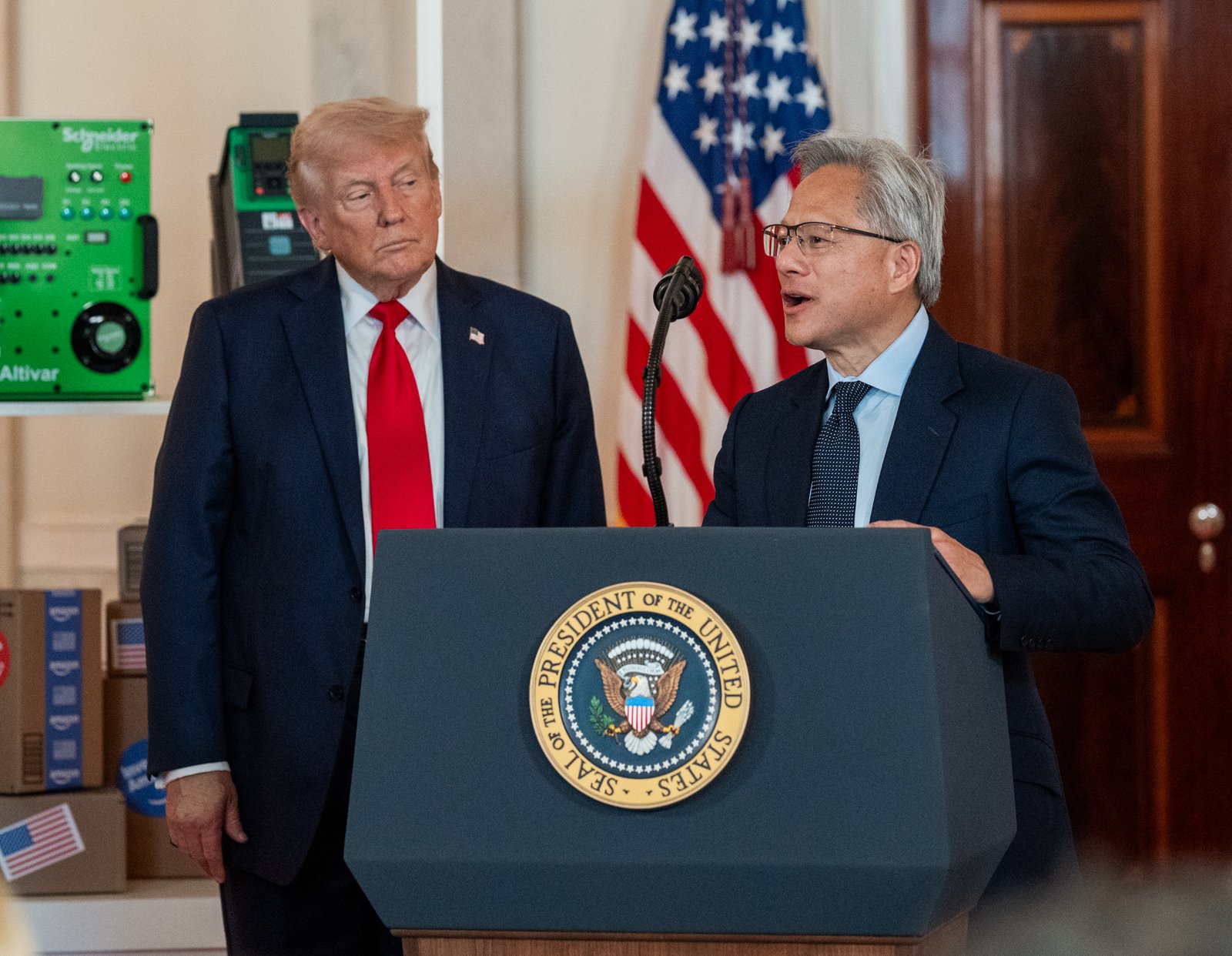
Nvidia reclaimed its position as the world's second-most valuable listed company on Monday, 23 November, after the return of Jensen Huang as chief executive sparked a historic rally in the artificial-intelligence chipmaker. The shares ended the US trading session 31.48% higher at $165.05, adding a record $952 billion in stock-market value in one day. The rebound took Nvidia past Microsoft and Alphabet, leaving only Apple ahead of it in the global ranking. 1 2 3
The change was remarkable in the space of one trading day. At Friday's close, Nvidia was valued at roughly $3.03 trillion and ranked fourth, behind Apple, Microsoft and Alphabet. During Monday's session its market value crossed $4 trillion and it moved into second place. Its closing valuation was nearer $3.99 trillion, underlining why a screenshot of an intraday ranking should not be described as the market's final settlement. 2 5 7
The distinction also explains the differing numbers attached to the rally. Two market-capitalisation snapshots showing about $3.031 trillion and $4.020 trillion imply a $989 billion difference, but those observations are taken at different market moments. MarketWatch calculated the record closing-session increase at $952 billion, using the day's official share-price move. Both describe a sharp repricing; neither means the company received hundreds of billions of dollars of new investment capital. 3 5 7
The immediate catalyst was Nvidia's announcement that its board had unanimously reinstated Huang as president, chief executive and director. It reversed the leadership transition announced on 12 November, which had put finance chief Colette Kress temporarily in charge. The board said consultations with senior US government officials had contributed to its confidence in the decision. That is the company's explanation for the reinstatement, rather than an independent verdict on all matters surrounding the earlier departure. 1 2 4
The rise did not stop at Nvidia. The technology-heavy Nasdaq Composite gained about 6.5% on Monday, while the S&P 500 advanced roughly 4.7%. Other semiconductor and AI-linked companies also rebounded as investors reconsidered the risks around the sector's most influential chip supplier. The breadth of the rally matters: a change in leadership at one company helped move major indexes, illustrating Nvidia's unusually large role in market sentiment. 2 4 6
The gain is not the same as a cash inflow to Nvidia. Market capitalisation is the market price of a share multiplied by the number of shares outstanding; it changes whenever investors agree to pay more or less for the stock. Monday's rise therefore measures how quickly the market reassessed the business under Huang's restored leadership. It does not establish that Nvidia's revenue, profit, factories or order book increased by a comparable amount overnight. 3 5
Nor did Monday's advance erase every loss from the preceding turmoil. Reuters reported that Nvidia remained below its value before Huang's resignation, despite the largest single-day addition to its market capitalisation. That leaves a more complicated interpretation than an uncomplicated victory lap: the market has assigned substantial value to restoring leadership continuity, but the company still carries the risk premium that emerged when its governance became uncertain. 2 3 4
The rally also raises a question about concentration. Huang co-founded Nvidia in 1993 and has been identified with its transition from gaming graphics processors to the computing systems at the centre of the AI boom. The scale of Monday's move suggests investors see his leadership as unusually difficult to replace. For a listed corporation, however, a founder's importance cannot remove the board's responsibility to apply consistent oversight and explain consequential decisions. 1 2 4
Those responsibilities remain relevant. Nvidia has said the independent investigation opened earlier this month will continue, alongside a new board committee overseeing national security and export controls. The company also outlined plans for additional compliance leadership. Huang's reinstatement answers the immediate question of who runs Nvidia, not how the inquiry will conclude or how the promised safeguards will perform once they are operational. 1 2
For businesses planning AI infrastructure, the event has a practical lesson beyond the share price. Nvidia remains a central supplier of advanced processors, but a near-trillion-dollar shift in valuation is a measure of market confidence, not evidence of a change in chip availability, contract pricing or delivery commitments. The next durable signals will come from operations and disclosures, rather than another movement in the ranking of global technology companies. 1 2 6