
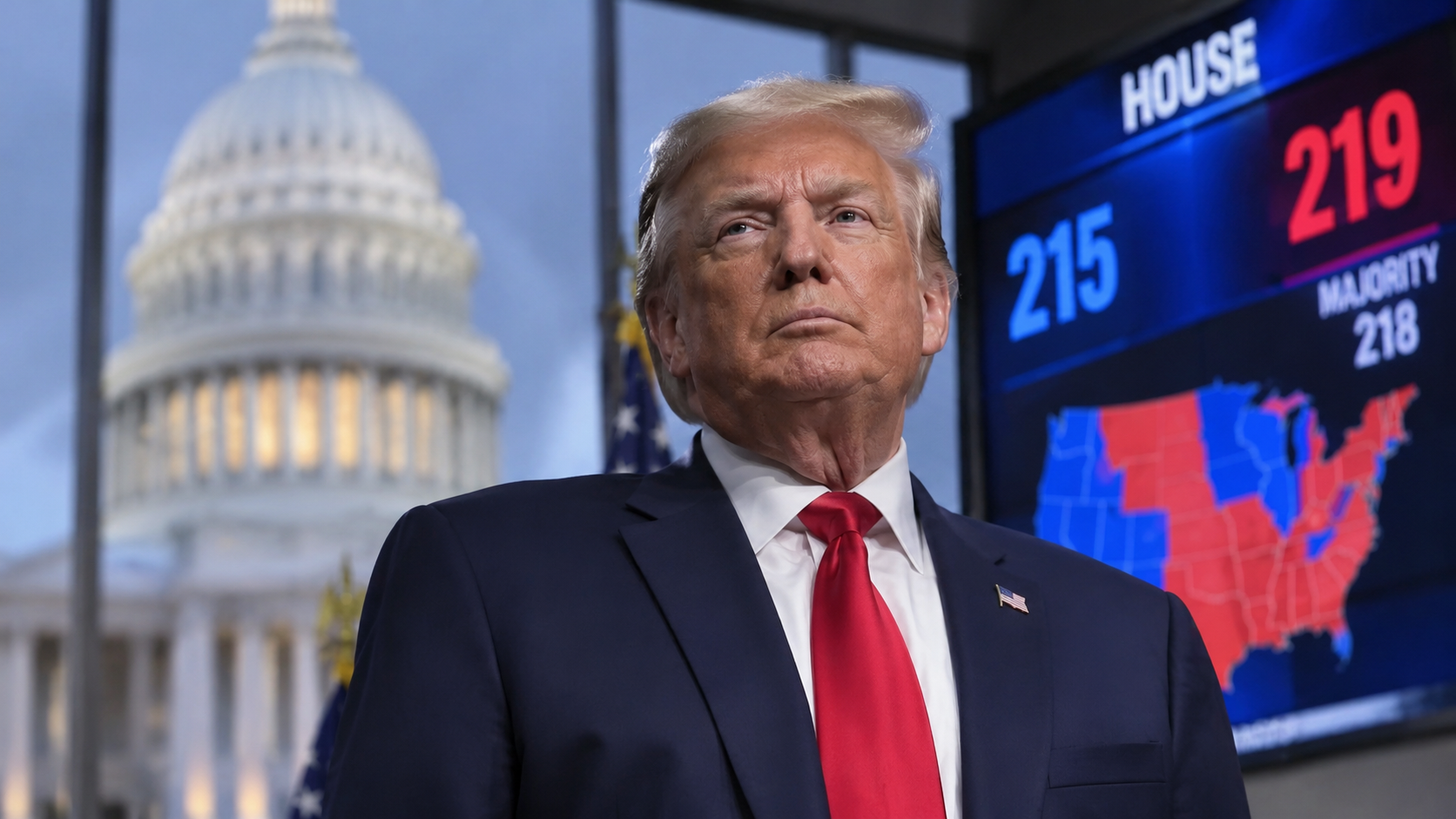
Donald Trump enters the last two years of his term without a Republican Congress. Democrats flipped the House and the Senate on 3 November in what Yahoo News called a historic rout,² and Indian markets reacted the next morning: the Sensex opened 2.08% higher at 78,910.94 as Brent crude slid toward $94–95.¹¹ For New Delhi the message is mixed. Oversight of the White House rises, surprise tariff shocks get harder, and the pressure to close a trade deal eases. Yet most trade, sanctions and visa powers are executive, and a Democratic Senate is no softer on Russian oil.⁴
What happened on 3 November
Democrats won the House and the Senate, ending unified Republican control for the rest of Trump's term. As of Wednesday evening, projections gave Democrats at least 242 House seats to Republicans' 151 with 42 races uncalled, and about 54 Senate seats to 44 with Mississippi and Alaska uncalled.¹⁰ Democrats flipped Senate seats in Iowa, Kansas, North Carolina, Ohio, South Carolina and Texas, according to Ballotpedia figures cited by the Daily Pioneer.⁹ Minority Leader Hakeem Jeffries has declared a bid for Speaker.¹
Voters treated the contest as a referendum on Trump, rising gas prices and the war in Iran.¹ Trump first distanced himself from the Republican showing,² then acknowledged that Democrats held both chambers, which cooled political uncertainty for investors.³ The Dow rose more than 3% on Wednesday, its strongest post-midterm session in over four decades, as traders bet that gridlock would limit big fiscal swings.¹²
Seat counts are still moving. Mississippi and Colorado were still being tallied when this was written.²
Trade and tariffs: fewer shocks, same wall
The pressure on India to close a trade deal has eased, but the tariff structure has not moved. Emkay Global says the 18% US tariff framework rate was never implemented, Indian goods now face a lower 10% Section 301 duty, and Washington has lost its IEEPA leverage.⁵ Its chief economist, Madhavi Arora, says the result changes Trump's incentives, not the tariff map: fewer new escalation tools, more pressure to deliver affordability, and deals needed before 2028.⁴ Future escalation must now run through slower, investigation-based Section 301 and 232 actions, which lowers the risk of overnight tariff shocks.⁴
There is a lot to protect. The US took $50.81 billion of India's merchandise exports in April–September 2026, up from $45.73 billion a year earlier.⁴ The live risks are Section 232 sector tariffs on pharma and electronics, and the USTR's Section 301 investigation into excess manufacturing capacity in India and 15 other countries, which could still add levies.⁴
The two sides read the opening differently. Indian officials told Bloomberg that tighter congressional scrutiny could give New Delhi room to resist terms it dislikes, while Ajay Srivastava of the Global Trade Research Initiative expects Trump to press for a quick win abroad to show American clout.⁶ Srivastava's advice is to demand enforceable reciprocal concessions and not let the rush to announce a deal outweigh getting a good one.⁴
Governance & policy: oversight rises, executive levers stay
A Democratic Congress gets the committee gavels and the power to investigate, subpoena and fund. It does not get the power to undo executive decisions: a bill or resolution overturning a proclamation or tariff emergency needs Trump's signature or two-thirds majorities in both chambers, and Democrats' projected margins fall short of that.¹⁰ The table shows who holds each lever that touches India.
| Lever | Who controls it | What the new Congress can do | | ----------------------------------------------------- | --------------------------------------- | -------------------------------------------------------------------------------------------------------------------------------------------------------------------------------- | | Tariffs on Indian goods (Sections 301, 232) | President | Hold hearings; reversal needs a veto-proof majority⁴¹⁰ | | Graham Act waiver on Russian-oil tariffs (up to 100%) | President (EO 14436, no expiry date) | Receive a certification and report; no vote on the waiver⁹ | | $100,000 H-1B petition fee | President (September 2025 proclamation) | Oversight and appropriations leverage over DHS¹⁰ | | 1% remittance excise tax | Already law | A bill raising it to 25% is unlikely to get a hearing⁹ | | US-India partnership, Quad, technology cooperation | Congress (non-binding) | Pass supportive resolutions at little cost⁹ |
Visas and immigration. India-born beneficiaries accounted for about 70% of approved H-1B petitions in fiscal 2025, according to USCIS data cited by IANS.¹⁰ The election also unseated Ohio Senator Jon Husted, who sponsored a bill to lift the H-1B wage threshold to about $140,000, and Ken Paxton, who as Texas attorney general investigated H-1B use at nearly 30 businesses, lost his Senate race to James Talarico.¹⁰ Democrats have already urged health-care exemptions from the fee. But proposed rules affecting H-1B workers and Indian students are executive actions that can proceed regardless of the vote,¹⁰ and CareEdge rates the near-term effect on H-1B rules as broadly neutral.⁷
Russian oil and sanctions. The Lindsey O. Graham Sanctioning Russia and Iran Act became law on 18 September 2026 and allows tariffs of up to 100% on the largest buyers of Russian crude, a group that includes India.⁹ Trump waived most of those penalties on 16 October under Section 115, with no expiry date, and Congress wrote no mechanism to end a waiver.⁸ What changes is scrutiny: Senate Banking and House Foreign Affairs pass to Democratic chairs who can question how the waiver is used, and CareEdge expects tougher examination of India's Russian oil and defence purchases.⁹⁷ Absent new legislation, analysts expect hearings and strongly worded letters rather than binding action.⁸
Strategic ties and the legislative calendar. Bills not enacted by 3 January lapse, so India-related proposals must be reintroduced in the 120th Congress.⁹ The pro-partnership Bera–Wilson resolution, which had about two dozen cosponsors, is likely to resurface, while Senator Bill Cassidy's India-focused agricultural trade bills lose their route once Senate Finance changes hands.⁹ Six Indian American House members are expected in the new Congress, all in the majority, including India Caucus co-chair Ro Khanna.¹⁰ Pending now is the FY2027 defence authorisation bill, a must-pass measure that gives lawmakers extra leverage.⁸
War powers and Iran. From January 2027 Democrats can attach conditions to funding for military operations, which CareEdge says may raise the pressure for diplomacy in West Asia.⁷ For India, that is the channel with the most direct economic payoff, because crude sets inflation, the current-account deficit and market sentiment.
Markets, oil and the Diwali wallet
The fastest transmission channel is crude. Brent fell 8.7% on Wednesday to settle at $94.62 a barrel and eased further on Thursday, which CareEdge calls the most immediate route from the election to India's inflation, current-account deficit and markets.⁷ Emkay notes that India's oil import bill is up 24% so far this fiscal year with Brent averaging $97, so the drop is a clear positive that also gives the RBI breathing space.⁵
Equities and the rupee followed. The Sensex opened up 2.08% at 78,910.94 on Thursday, against a close of 77,301.40 a day earlier, and the Nifty opened near 24,378.¹¹ The rupee closed at 94.64 per dollar on Wednesday, its fourth straight gain, helped by a softer dollar and lower crude.¹² Foreign portfolio investors bought ₹14,863 crore of equities in November so far, after ₹34,843 crore of outflows in October, according to NSDL data cited by Business Today.⁴ The relief has limits. Emkay expects the RBI to use durable inflows to rebuild reserves against a $239 billion forward-dollar liability, which caps rupee gains by policy choice.⁵
This lands on households at a tight moment. Diwali falls on Sunday, 8 November, with Dhanteras on Friday, 6 November.¹³ Retail inflation was 5.54% in September and the RBI raised the repo rate by 25 basis points to 5.50% on 7 October, expecting inflation to peak near 6% in the festive quarter.¹³ LocalCircles expects urban festive spending to fall 6% to ₹1.97 lakh crore, while traders' body CAIT projects festive trade above ₹7 lakh crore, a gap that suggests higher prices rather than higher volumes are doing much of the work.¹³ Cheaper crude will not cut those prices by Dhanteras, but it improves the odds that inflation peaks on the RBI's projection instead of overshooting it.
What to watch next
- Dhanteras tallies (6 November): jewellers' bodies will report value and volume; flat tonnage with higher value would confirm the price-led pattern.¹³
- October CPI (12 November): it will show whether inflation is peaking near the RBI's 6% projection as crude falls.¹³
- RBI policy (4 December): the central bank decides whether October's hike becomes two.¹³
- Final US counts: Mississippi and Alaska were still uncalled, and House margins decide how much leverage Democrats really have.¹⁰
- Lame-duck session to 3 January: the defence authorisation bill moves, India-specific bills lapse, and the Graham Act waiver stays in force.⁸⁹
- Trade and tariff signals: any Section 232 move on pharma or electronics, the Section 301 capacity probe, and whether a deal text emerges.⁴
- West Asia: Brent stays sensitive to the Strait of Hormuz, and the January funding fights decide how much diplomacy Congress can force.⁷
What it means for India
The midterms shift the balance of risks more than they change the rules, which is how CareEdge puts it.⁷ The gains are cheaper oil, calmer tariff headlines and a bit more negotiating room. The exposures are unchanged: Section 232 sector duties, a Russian-oil tariff waiver that one executive order can end, the H-1B fee, and a Congress that is no softer on Moscow. Households and investors should treat this week's rally as relief, not a regime change. This article is for general information and is not financial or investment advice.
How we reported this
Figures come from the sources above, which were published between 4 and 5 November 2026. US seat counts and Indian market levels were still moving when this was written and will change. Several outlets cited here are syndicated wire copy (PTI, IANS, ANI); the Emkay and CareEdge views are analyst opinions.