
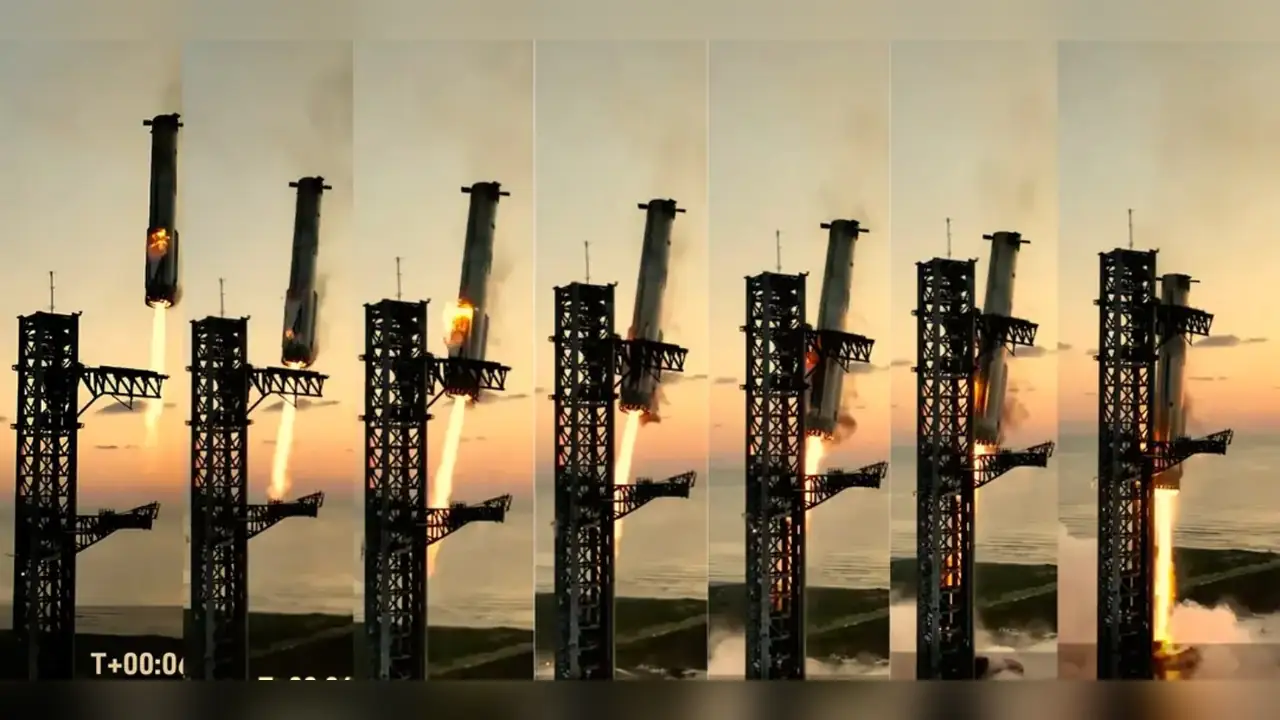
“Mechazilla catches Starship!” was SpaceX's announcement after Ship 42 returned to its launch tower at Starbase, Texas, on 14 November 2026. The upper-stage spacecraft had been launched the previous evening on the company's fifteenth integrated Starship test, then spent approximately 22½ hours in flight, completing 14 orbits and delivering 26 Starlink V3 satellites. Its capture by the tower's two mechanical arms was the first successful catch of a Starship upper stage returning from orbit. It was not the capture of a satellite, nor the first booster catch: SpaceX had previously recovered Super Heavy boosters using the same type of hardware. 1 2 6
The difficulty lay in bringing home the spacecraft that actually reaches orbit. A Super Heavy booster separates within minutes of launch, while Starship's upper stage must survive prolonged flight and re-enter the atmosphere at roughly orbital velocity. SpaceX's published Flight 15 timeline scheduled a deorbit manoeuvre more than 21 hours after launch. After its satellite deployment, Ship 42 continued orbiting Earth while flight controllers reviewed telemetry and images of its thermal protection. Observations came both from long-range cameras and from cameras carried on some of the newly deployed satellites, providing an additional check before committing to re-entry. 1 3
The return began with a roughly ten-second burn of one Raptor engine, reducing the spacecraft's orbital energy enough to put it on a trajectory back into the atmosphere. At higher altitudes, heat-shield tiles protected critical parts of the vehicle as atmospheric friction heated the surrounding air; aerodynamic flaps and onboard guidance contributed to controlling its descent. These systems are distinct from the tower's arms. The tower could not rescue a spacecraft arriving too fast or at the wrong angle: Ship 42 had to shed almost all of its orbital speed and reach the launch site on a precise, controlled path before capture was possible. 3 2
In the final moments, the returning spacecraft approached in a near-horizontal orientation and fired three Raptor engines to begin its landing manoeuvre. Engine thrust rotated it upright and slowed its descent, after which successive engine shutdowns reduced the amount of thrust as the vehicle settled toward the tower. SpaceX's mission timeline had specified the landing burn, flip and engine reductions within seconds of each other. At the correct position, load-bearing fittings on Starship engaged the tower's two steel arms, nicknamed the “chopsticks”. The arms then supported the vehicle, allowing its remaining engine to shut down. In engineering terms, this was a guided powered landing onto a fixed capture mechanism, not an uncontrolled falling rocket being grabbed. 1 4
The operation was not a complete two-stage recovery. Flight 15's Super Heavy booster was intended to return to the tower soon after launch on 13 November but diverted toward the Gulf of Mexico instead. During the following day's webcast, SpaceX said preliminary indications pointed to a low-fuel-mass warning that ended the boostback burn early. The booster guidance system determined it was not correctly positioned for a tower catch and made an automated diversion. The booster was lost, and the underlying cause remained under investigation. The failed return therefore should not be described as a successful double catch, even though the upper-stage recovery was a substantial technical milestone. 3 2
Mechazilla's business case is about shifting the mass and expense of recovery equipment away from the flying rocket and onto reusable ground infrastructure. A spacecraft that does not carry conventional landing legs can potentially devote more of its mass to payload or propellant. If the same tower can receive a returning vehicle repeatedly, the system could eventually shorten turnaround times. Neither advantage is automatic: structural inspection, heat-shield work, refuelling, ground handling and the reliability of repeated catches will determine whether recovery becomes cheaper than replacing hardware. A successful first capture demonstrates technical feasibility, not yet an airline-like operating cadence. 2 4
The stakes extend beyond Starlink. SpaceX aims to use Starship for larger and more frequent payload deliveries, while NASA is funding development of a specialised Starship Human Landing System to carry astronauts between lunar orbit and the Moon's surface. NASA's programme description makes clear that lunar operations involve additional requirements and tests beyond returning a spacecraft to a launch tower. Ship 42's flight makes one critical part of full vehicle recovery more credible, while leaving repeated reuse, two-stage recovery and the lunar variant's separate engineering milestones to be demonstrated. 5 2