
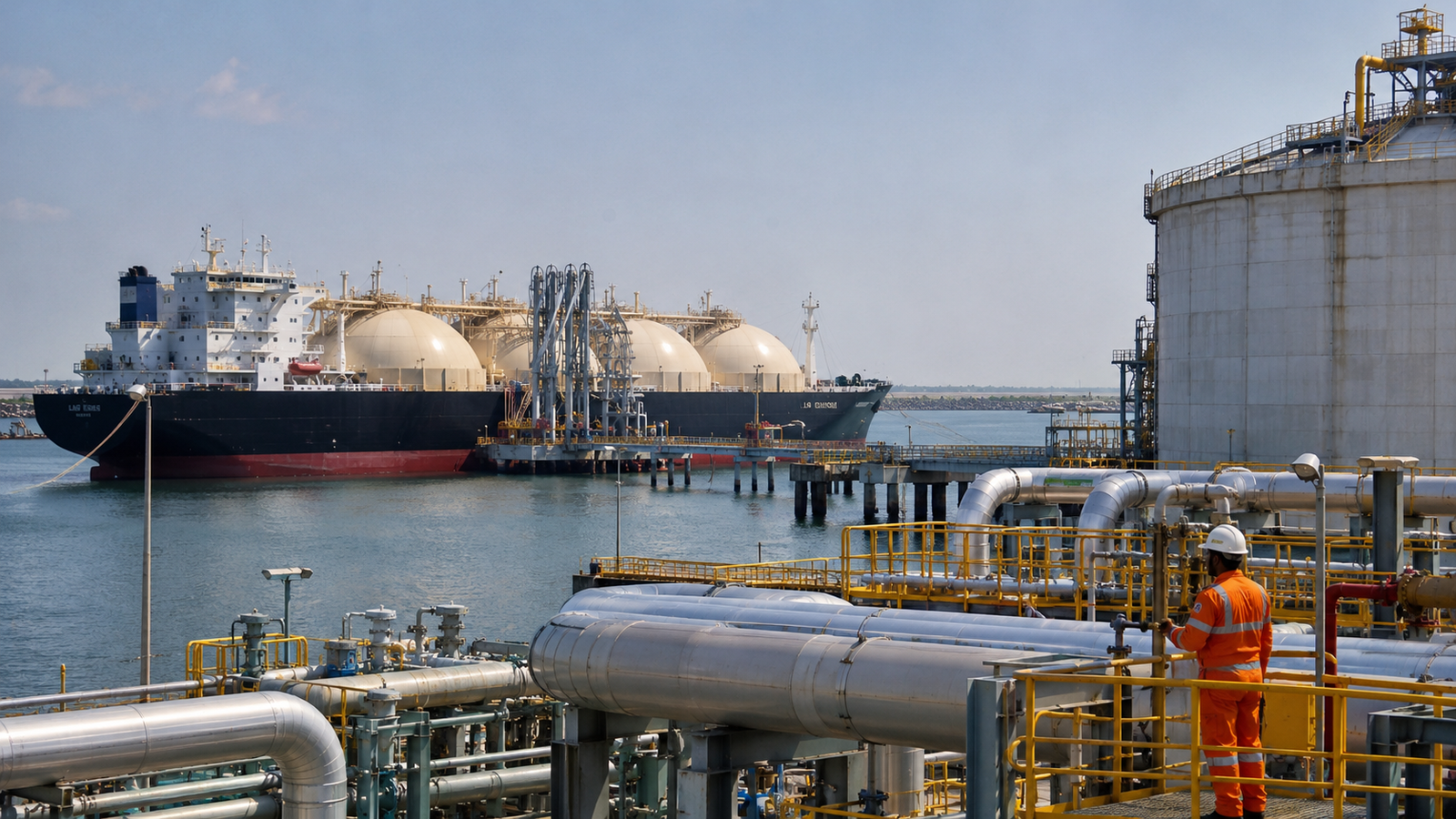
India's latest natural gas agreement was announced on November 6, when Abu Dhabi National Oil Company signed a ten-year contract to supply Gujarat Energy Ltd with up to four million tonnes of liquefied natural gas, beginning in 2028. The agreement, ADNOC's fifth LNG supply arrangement with Indian buyers, follows a series of long-term commitments involving some of the country's largest energy companies. Earlier this year, Hindustan Petroleum Corporation signed a ten-year supply agreement with an ADNOC Gas subsidiary, while Petronet LNG continued preparations for a separate contract under which QatarEnergy is expected to supply 7.5 million tonnes annually until 2048. These arrangements reflect India's expectation that natural gas will become increasingly important to manufacturing, urban transport and industrial energy consumption. They also raise a financial question that has become more urgent following disruptions to Middle Eastern energy supplies: when a buyer commits to purchasing gas years before it is consumed, who bears the consequences if market prices move sharply, the rupee weakens or the gas fails to arrive? ¹ ²
The question has acquired new significance because long-term supply arrangements did not prevent India from experiencing a severe interruption in LNG deliveries during 2026. Following the escalation of the war involving Iran, the United States and Israel, the disruption of shipping through the Strait of Hormuz and attacks affecting Qatar's Ras Laffan energy facilities interrupted one of India's most important sources of imported gas. QatarEnergy declared force majeure on supplies in March, with the disruption subsequently extended through December. Petronet told analysts in early November that it was discussing the eventual delivery of delayed cargoes and negotiating the possibility of receiving some American-produced LNG through its renewed contract with QatarEnergy. The development illustrated the distinction between securing a contractual entitlement to gas and ensuring that physical cargoes can reliably reach the intended market. A twenty-year agreement can provide commercial continuity, but it cannot eliminate geopolitical, shipping or production risks. ³
The scale of India's exposure is substantial. The International Energy Agency projected in its 2025 India Gas Market Report that natural gas consumption could rise by nearly 60% between 2023 and 2030, reaching approximately 103 billion cubic metres annually. LNG imports, which reached around 36 billion cubic metres in 2024, were projected to climb to 64 billion cubic metres by 2030. These forecasts were made before the full consequences of the 2026 Middle East disruption became apparent and should therefore be treated as a baseline outlook rather than an assured outcome. Nevertheless, the underlying problem remains: domestic gas production is not expected to grow quickly enough to meet all the additional demand anticipated from city gas networks, industrial users and other sectors. Without an adequate portfolio of contracted supplies, importers become more dependent on international spot markets, where prices can change abruptly in response to weather, shipping disruptions and competing demand in Europe and Asia. ⁴
A long-term contract is not a fixed-price contract
The central misunderstanding surrounding LNG agreements is that committing to buy gas for ten or twenty years necessarily locks in a particular price. In practice, long-term contracts frequently contain pricing formulas that change with international commodity benchmarks. Many traditional Asian LNG contracts are linked to crude oil, particularly Brent, while American LNG agreements commonly reference Henry Hub natural gas prices. Other arrangements use hybrid formulas, market-linked adjustments or negotiated provisions that are not publicly disclosed. The commercial outcome depends on the index selected, the percentage applied to it, any fixed charges and the contractual conditions governing revisions. Long-term contracts can therefore reduce uncertainty about available volumes while leaving buyers exposed to substantial changes in what those volumes will cost.
Petronet's relationship with Qatar provides an illustration. Under its existing agreement, the reported pricing formula links LNG to 12.67% of Brent crude prices, with an additional fixed charge of approximately $0.52 per million British thermal units. When the company renewed its principal 7.5-million-tonne annual supply agreement in February 2024, industry reporting suggested that the revised arrangement would eliminate the fixed charge and improve delivery terms. The replacement agreement, scheduled to begin in 2028 and continue until 2048, also moves supplies from a free-on-board arrangement to a delivered basis. Under the earlier system, the Indian buyer arranged shipping; the revised structure places greater responsibility for delivery on the seller. However, Petronet did not publicly disclose the complete revised pricing formula. The reported terms of the existing agreement should consequently not be presented as the final, binding price of gas supplied under the new one. ⁵ ⁶
That difference has financial consequences. An oil-indexed agreement can become more expensive when Brent rises even if regional natural gas demand remains relatively unchanged. Conversely, it may become attractive when LNG spot prices increase more rapidly than oil-linked contract prices. Henry Hub-linked contracts offer exposure to a different market, potentially reducing dependence on crude-price movements but introducing risks associated with American gas production, liquefaction charges, shipping and transatlantic freight costs. Neither structure guarantees the lowest price throughout a contract's duration. According to the IEA's Gas 2025 report, oil-indexed agreements represented approximately 61% of LNG export contracts in 2024, down from more than 70% in 2016. The share is expected to decline further as additional American export capacity enters service. Buyers are therefore increasingly able to diversify not only the countries from which they obtain gas, but also the benchmarks determining its price. ⁷
The new ADNOC agreements reveal another limitation in public understanding of these commitments. Gujarat Energy's contract covers up to four million tonnes over the entire ten-year period, not four million tonnes annually. It is therefore much smaller in scale than Petronet's arrangement with Qatar. The Gujarat agreement also draws on the international portfolio of XRG, ADNOC's investment company, rather than being described as a commitment tied exclusively to a particular Gulf production facility. That distinction potentially provides greater geographical flexibility, although the full delivery obligations and price provisions have not been published. HPCL's separate agreement provides for 0.5 million tonnes annually over ten years, with ADNOC assigning it a contractual value of approximately $2.5 billion to $3 billion. Such an announced value offers an indication of commercial scale, not proof that every future cargo is purchased at an identical fixed price. ¹ ²
Where the financial exposure moves
The first party exposed to changing LNG prices is generally the importing or purchasing company, subject to the particular contract's terms. But Indian gas supply chains often contain multiple commercial arrangements between the original importer and the eventual consumer. Petronet's Qatar agreement illustrates this structure. The company has substantially back-to-back arrangements under which GAIL receives 60% of contracted volumes, Indian Oil Corporation 30% and Bharat Petroleum Corporation 10% after regasification. These arrangements help distribute contractual commitments across established downstream buyers rather than leaving the importer to market every cargo independently. Yet the existence of back-to-back contracts does not establish that all commercial risks disappear. The extent to which price changes, minimum purchase obligations and interruptions can be transferred depends on the actual terms negotiated with each buyer and subsequently with their customers. ⁸
For GAIL and other gas marketers, the challenge involves matching commitments made to foreign suppliers with demand from domestic customers. A long-term agreement may contain take-or-pay provisions requiring payment for agreed minimum quantities even when the buyer cannot immediately use the gas, subject to contractual qualifications and make-up rights. Other agreements provide different forms of flexibility. The commercial risk becomes particularly important when imported LNG is expensive relative to alternative fuels or when domestic industrial demand falls short of expectations. If the buyer can pass the cost through under downstream contracts, some exposure moves to the consumer. If not, the importing or marketing company may face pressure on margins, cash flow or inventory management. GAIL has acknowledged risks associated with adverse changes in crude and LNG prices, cargo shortages and supplier defaults, while describing hedging and back-to-back arrangements among its mitigation measures. ⁹
The exposure becomes more visible during a supply interruption. On November 2, Reuters reported that approximately 75 to 80 LNG cargoes contracted by Petronet had been delayed during the Middle East conflict. The company was negotiating their eventual delivery, while additional cargoes associated with an earlier pricing dispute remained outstanding. The relevant contractual provisions reportedly permit delayed deliveries through April 2029. These circumstances demonstrate that force majeure and delivery flexibility can affect the timing and economic value of a supply agreement even when the buyer has entered a long-term contract. If a cargo is unavailable when required, the buyer may need replacement gas at prevailing market prices, reduce downstream supplies or rely on other contractual sources. Whether the original supplier must compensate the buyer depends on the agreement and the legal treatment of the disruption. ¹⁰
The experience of 2026 provides a measurable indication of the resulting pressure. In March, Crisil Ratings reported that Asian spot LNG prices had climbed to approximately $19–20 per million British thermal units, compared with $10–11 in February. That increase materially altered the economics of replacing contracted supplies with emergency purchases. Crisil expected sales volumes among city gas distribution companies to decline by 8–10% during the disruption, with industrial and commercial customers particularly exposed. The agency also concluded that the ability of distributors to pass through higher costs would help cushion profitability. That mechanism explains why a gas importer or distributor can remain financially stable while the businesses purchasing its gas face higher operating expenses. Risk is not eliminated simply because it is successfully transferred to another participant in the supply chain. ¹¹
For smaller manufacturers, the consequences may be harder to absorb. Ceramic producers, chemical manufacturers, engineering firms and businesses using natural gas for industrial heat often operate under contracts that limit their ability to raise selling prices immediately. A sustained increase in gas costs can therefore compress margins or make production uneconomic. Crisil identified ceramics among the sectors particularly vulnerable to disruptions in LNG availability, with some manufacturers facing reduced plant utilisation or temporary shutdowns. Larger industrial buyers may be able to negotiate pricing arrangements, purchase alternative fuels or hedge portions of their exposure. Smaller enterprises generally have fewer such options. The consequence is that a supply decision made by a major energy importer can eventually influence production schedules and working-capital requirements across businesses that have no direct involvement in the international LNG market. ¹²
Households and transport users face a different arrangement. Following the Middle East disruption, the government introduced the Natural Gas (Supply Regulation) Order in March 2026, establishing priority allocations for domestic piped gas and compressed natural gas used in transport. Fertiliser plants and industrial consumers received lower priority under the emergency framework. The measures demonstrated that the government can intervene to protect essential consumption during a supply shortage, including through regulated allocation and pooled pricing arrangements. They did not create an unlimited supply of gas or remove the associated cost. When imports become scarce or expensive, protecting one category of consumers can require reductions elsewhere, higher procurement costs or intervention by public-sector institutions. ¹³
Fertiliser production provides a particularly important example of how price risk can ultimately reach public finances. Natural gas is a major feedstock for domestic urea manufacturing, while the retail price paid by farmers is regulated. When production costs rise, the government may bear a greater portion of the difference through its subsidy arrangements rather than allowing the full increase to appear in the farmer's purchase price. India's Union Budget for 2026–27 allocated approximately ₹1.71 lakh crore to urea and nutrient-based fertiliser subsidies combined. The figure covers a wider range of costs than natural gas alone, and should not be interpreted as the fiscal expense attributable solely to LNG imports. Nevertheless, the subsidy mechanism means international energy-price shocks can affect government expenditure even when retail fertiliser prices remain comparatively stable. In these circumstances, a portion of the risk associated with imported gas is effectively absorbed by taxpayers. ¹⁴
Currency movements introduce another layer of exposure. International LNG contracts are commonly denominated in dollars, while Indian industrial customers generate most of their revenue in rupees. A weaker rupee can increase the domestic cost of imported gas even when the international benchmark remains unchanged. Importers may hedge currency exposure for selected periods, and some downstream agreements allow price adjustments, but neither mechanism necessarily protects every participant throughout a ten- or twenty-year contract. A business purchasing gas under a rupee-denominated supply agreement can still experience the effects of depreciation if its supplier passes through changes in procurement costs. This creates a second financial variable alongside commodity prices, particularly for manufacturers whose finished products compete against imports or are sold under fixed-price contracts.
The case for long-term contracts, despite the risks
None of these vulnerabilities means that India should depend entirely on spot purchases. Long-term agreements remain essential to financing new LNG production and securing sufficient volumes in a market where large export facilities require substantial capital investment. Producers obtain greater confidence that customers will purchase future output, while buyers reduce the risk of being unable to obtain gas during periods of exceptional demand. The IEA reported that agreements lasting at least ten years accounted for approximately three-quarters of LNG volumes contracted globally since 2022. The continued importance of these agreements reflects a commercial balance: producers need reliable demand to justify investment, and importing countries need dependable supplies to support industry and infrastructure. ⁷
India's current challenge is therefore one of contract design rather than simply contract duration. Diversifying suppliers reduces dependence on a particular exporting country, but it does not automatically eliminate exposure to common shipping routes or correlated international prices. Contracts linked to different benchmarks can provide some financial diversification, while destination flexibility and replacement-supply provisions may improve resilience during disruptions. Delivered contracts can shift certain transportation responsibilities to suppliers, although their costs may still be reflected in negotiated prices. A diversified portfolio of long-term, medium-term and spot purchases can also reduce dependence on a single market condition. The appropriate balance depends on demand forecasts, customer affordability and the value placed on security of supply.
The latest negotiations between Petronet and QatarEnergy suggest that buyers are increasingly attentive to these distinctions. QatarEnergy has been expanding its international procurement portfolio, including agreements associated with American LNG production, while Indian buyers are seeking alternatives to supplies disrupted by the Gulf conflict. The arrangement under discussion could allow some gas purchased through QatarEnergy to originate outside Qatar, subject to further agreement. Such a structure would not remove price or contractual risk, but it could reduce dependence on a single production location and shipping corridor. Its effectiveness would depend on the volumes available, delivery obligations and treatment of additional costs. ³
There is also uncertainty about future demand. India's objective of increasing natural gas's share of its energy mix to 15% by 2030 depends on expanding infrastructure and keeping gas economically competitive with other fuels. The IEA's demand projections provide a case for additional contracting, but they are not guarantees that industry will consume the anticipated volumes at any price. Gas-fired power generation offers a warning: India has substantial installed gas-based generating capacity that has historically operated well below its potential because affordable fuel has been scarce. An importing strategy that secures more gas than consumers can economically absorb could create costs of its own. Equally, failing to contract sufficient volumes could leave the economy exposed to another period of elevated spot prices. Both risks deserve consideration before additional long-term commitments are made. ⁴ ¹⁵
The question of who bears India's LNG price risk consequently has no single answer. Foreign suppliers retain obligations and exposures defined by their contracts, while Indian importers and gas marketers manage commodity, currency, volume and counterparty risks. Industrial consumers may ultimately pay more for energy, households may experience adjustments to gas tariffs, and the government can absorb additional costs through subsidies or emergency interventions. How much reaches each participant depends on contractual provisions, market conditions and public policy. Because the complete pricing formulas and allocation of liabilities are not publicly available for every agreement, the precise financial burden cannot be calculated from the announced volumes and contract values alone.
India's long-term gas strategy is understandable in a country whose future energy requirements are expected to exceed what domestic production can provide. But the experience of 2026 has demonstrated that energy security cannot be measured simply by the number of years covered by a supply agreement. A contract may secure access to gas without ensuring that it is affordable, and it may guarantee commercial obligations without guaranteeing uninterrupted physical delivery. As India's energy companies commit to purchases extending into the 2040s, the durability of those agreements will depend on how successfully they distribute risks between producers, importers, customers and the public sector. The most consequential terms may not be the headline volumes or contract durations, but the provisions determining what happens when the market moves against the buyer.