
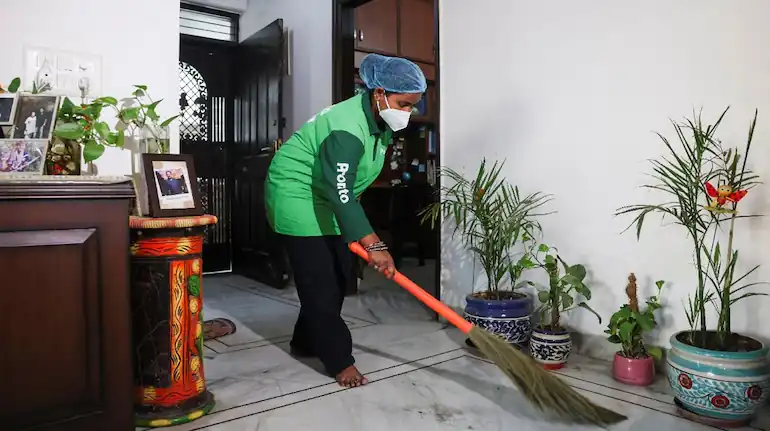
Tap an app in Bengaluru, Gurugram or Mumbai today and, depending on where you live and who is available, someone may arrive at your door within minutes to clean your home. Snabbit advertises house help starting at ₹99 an hour. Apps like Urban Company’s InstaHelp, Snabbit and Pronto have turned sweeping, mopping and dishwashing into impulse, on-demand bookings.14
The pitch to consumers is straightforward. Behind the introductory discounts, though, sits a stubborn maths problem: unlike grocery delivery or AC repair, house cleaning has no physical goods or spare parts to mark up. It is primarily human time and effort. Urban Company’s disclosures show that InstaHelp recorded an adjusted EBITDA loss of ₹279 per order against a net order value of ₹114 in the July–September 2026 quarter. That is a platform-level operating loss measure, not the amount spent on wages and direct labour costs alone.2
Urban Company, Q2 FY27. Losses shown as positive magnitudes; these are not worker wages. 2
When venture capital underwrites human labour at a steep loss, it can create an artificial market. The real question is not whether people will tap an app for a ₹99 booking today, but what happens to customers and workers once prices adjust to reality.
What This Means for Customers: Convenience vs. Fatigue
For urban households, instant bookings promise freedom from the headache of finding and managing regular help. Applying ten-minute delivery logic to the home, however, brings three hidden costs:
The Daily “Onboarding Tax”: Grocery delivery works because a carton of milk is the same no matter who hands it to you at the gate. Domestic work is personal and routine-driven. When an app sends a different worker every morning, speed can turn into mental exhaustion. You spend part of each visit repeating the same instructions—which cloth cleans the kitchen counter, where supplies are kept, how to wash certain utensils—while keeping an eye on an unfamiliar person in your home.
The Trust Gap: Traditional neighbourhood hiring relies on local social checks: society gate logs, neighbour referrals and years of shared accountability. Apps try to supplement that with identity checks, training and background verification. Snabbit also offers preferred-worker matching when available. For families with elderly parents or women living alone, letting a rotating roster of unfamiliar people into private homes can create real friction that a discount only temporarily hides.13
The Price Reset: Introductory rates are not necessarily permanent. Urban Company has said lower prices are part of attracting new customers, and that it expects average order values to rise over time. If booking help every day on an app becomes materially more expensive, some households may return to monthly arrangements; others may use the apps only when they need occasional help.2
What This Means for Workers: Short-Term Boost, Long-Term Risk
For domestic workers, most of them women, the immediate pitch can be hard to turn down: access to new customers, more structured bookings and the prospect of higher earnings while a platform expands. But a higher advertised hourly rate means little unless the worker has enough paid hours, manageable travel and dependable payouts. Once platforms tighten their belts, that same economics can leave workers exposed:
The Commute Ceiling: Cab drivers and delivery riders can move across a city to find more work. Domestic workers often operate within tighter neighbourhood boundaries shaped by transit costs, safety and care responsibilities at home. Travelling several kilometres between two low-value bookings eats up unpaid transit time and shrinks their real hourly wage.
The Off-App Squeeze: Because trust is scarce, the moment a worker and a household click, both sides may have a financial reason to cut out the app and agree on a direct monthly cash arrangement. Platforms can respond by making repeat bookings more attractive, or they may consider tighter terms. The latter is a risk to watch, not an established practice of the companies named here.
The Subsidy Cliff: Traditional neighbourhood work, for all its informality, can offer relatively steady monthly cash flow and an ongoing relationship with households. Workers who give up those local ties during a venture-funded boom risk being stranded if incentives dry up, consumer prices rise and daily orders slow down.
There is a counterargument worth taking seriously. Urban Company says denser networks are already cutting travel time and support costs, improving service-professional utilisation. InstaHelp’s adjusted EBITDA loss per order narrowed from ₹346 in the previous quarter to ₹279 in September. Better unit economics do not make the losses disappear, but they do show why today’s subsidised price need not be tomorrow’s permanent business model.2
Cheap capital can temporarily make human labour look like an on-demand software utility. Even inside the sector, some companies are exploring value beyond cleaning fees. Inc42 has reported on Pronto’s opt-in service that records household chores for physical-AI training, alongside a separate robotics-data venture founded by Pronto’s founder. The commercial relationship between those businesses has not been established.4
For households and workers, though, the takeaway is simple: you cannot code away the real cost of an hour of human work. Until platforms price services around fair, sustainable wages instead of temporary discounts, both sides may be operating inside a subsidy bubble that cannot hold forever.