
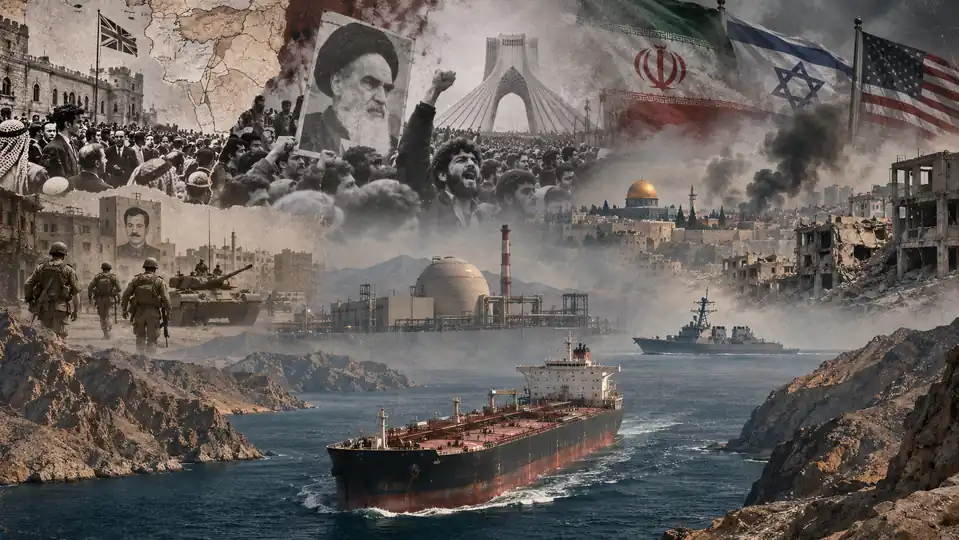
On 7 November 2026, an American military aircraft struck a commercial cargo vessel in the Gulf of Oman. US Central Command said the ship had visited an Iranian port and was attempting to evade the American blockade of Iran; that explanation is the military’s account, not an independently established finding about the vessel’s intentions. Two days later, Qatar’s prime minister was due at the White House, where diplomats were still attempting to narrow the differences between Washington and Tehran. The juxtaposition captured the current Middle East crisis: military pressure at sea, talks conducted through intermediaries and no agreement capable of restoring predictable commercial passage. 15 16
An account beginning with the strikes of 28 February 2026 would explain the immediate war, but not why Iran and Israel became enemies after a period of cooperation, why the United States came to dominate Gulf security, or why shipping through a waterway between Iran and Oman has become a central instrument of coercion. Those developments arose through a series of political decisions stretching across more than a century. The history does not establish that the present war was inevitable. It identifies the institutions, rivalries and unresolved questions within which today's decisions are being made.
The post-Ottoman settlement and the unresolved Palestinian question
The First World War transformed the political map of much of the Arab Middle East. Ottoman defeat was followed by British and French mandates over territories including Iraq, Palestine, Syria and Lebanon. The 1916 Sykes–Picot agreement had anticipated spheres of European influence, although the eventual postwar boundaries and arrangements did not simply reproduce its map. Local nationalist movements challenged external rule and sought self-government, with varying outcomes. The resulting states acquired political institutions and borders while competing national aspirations continued to shape the region. 1
Palestine followed a related but separate history. Britain's 1917 Balfour Declaration supported a Jewish national home in Palestine while its Arab inhabitants demanded political rights and self-determination. Jewish immigration, intensified by persecution in Europe, and opposition among Palestinian Arabs hardened conflicting expectations. The United Nations proposed partition in 1947. Israel declared independence in May 1948, war followed, and hundreds of thousands of Palestinians fled or were expelled from their homes. The 1967 war brought the West Bank, East Jerusalem and Gaza under Israeli occupation. Territorial control, displacement, security and statehood remained unresolved. 1 2
Those disputes were not the source of every subsequent conflict. Iran’s confrontation with Iraq had its own strategic and territorial origins; competition among Gulf monarchies and revolutionary movements also followed distinct courses. Yet the Palestinian question became a language through which governments and movements justified regional alliances, military action and claims to legitimacy. Later Iranian leaders incorporated opposition to Israel into their state ideology, turning an older Arab–Israeli conflict into one element of a wider confrontation involving Tehran.
Iran before 1979: an American ally, not an inevitable adversary
Iran was formally independent through the period of European mandates, but British and Russian interference significantly constrained its autonomy. Oil concessions became a focus of nationalist opposition. Prime Minister Mohammad Mossadegh’s government sought national control over petroleum in 1951, and the ensuing confrontation with Britain brought economic pressure and political destabilisation. On 19 August 1953, Iranian opponents of Mossadegh, supported by British and American intelligence, overthrew his government. Declassified records confirm CIA involvement. The episode became central to a durable Iranian account of interference by foreign powers. 3 4
The Shah, Mohammad Reza Pahlavi, emerged with a strengthened position and deepened Iran’s military and economic relationship with Washington. His government pursued modernisation and expanding regional power, while severely restricting opposition. For American planners, Iran was a major partner against Soviet influence and a pillar of security around the Persian Gulf. The subsequent hostility of the Islamic Republic should therefore not be mistaken for a permanent feature of US–Iran relations: the countries cooperated for much of the Cold War. 4
Iran and Israel also maintained strategic and commercial cooperation under the Shah. Neither government viewed their relationship as a public ideological alliance, but both recognised shared security interests in a region dominated by hostile Arab nationalist governments. That relationship later inverted. The change was political and strategic, not the expression of a timeless religious hostility. It is an important reminder that the alliances now taken for granted were constructed, and can in principle be changed.
1979: the revolution that reordered the Gulf
The 1979 Iranian Revolution overthrew the monarchy after a broad movement of clerical, nationalist, secular and left-wing opposition. Ayatollah Ruhollah Khomeini emerged as the dominant leader of the new Islamic Republic. Washington lost a close regional partner, while the revolutionary government rejected Israel’s legitimacy and made opposition to American influence a defining foreign-policy position. The seizure of the US embassy in Tehran in November 1979 led to a 444-day hostage crisis and the rupture of formal diplomatic relations. In Washington and Tehran, the events of 1953 and 1979 became competing reference points for understanding the other side’s intentions. 4
Iran’s neighbours were alarmed by the possibility that revolutionary politics might cross their borders. Saddam Hussein’s Iraq invaded Iran in September 1980, beginning an eight-year war marked by immense casualties, attacks on cities and the use of chemical weapons by Iraqi forces. The war entrenched Iran’s sense of strategic isolation and drove several Gulf monarchies closer to Iraq and the United States. Saudi Arabia, Kuwait, Bahrain, Qatar, the United Arab Emirates and Oman established the Gulf Cooperation Council in 1981. Their subsequent policies were not identical, but insecurity about Iran's revolution helped shape their collective institution. 1
As the war continued, commercial tankers and energy facilities became targets. In the so-called Tanker War, Iran and Iraq attacked shipping linked to their opponents, exposing neutral crews and the world oil market. The United States began escorting reflagged Kuwaiti vessels. After the frigate USS Samuel B. Roberts struck an Iranian mine on 14 April 1988, American forces attacked Iranian naval targets four days later in Operation Praying Mantis. On 3 July, the US cruiser USS Vincennes shot down Iran Air Flight 655, killing all 290 aboard. US naval history attributes that destruction to a catastrophic misidentification. The events created memories of maritime confrontation and civilian loss that persist on both sides. 5 6
Regional armed groups, Iraq and the expansion of the conflict
Iran also developed relationships with armed movements outside its borders. Following Israel’s 1982 invasion of Lebanon, the Islamic Revolutionary Guard Corps helped organise and support militants who became Hezbollah. The organisation developed as a Lebanese military and political force while maintaining substantial ties with Tehran. Iran later supported Palestinian Islamic Jihad, Hamas and armed groups in Iraq; it also formed a relationship with the Houthis in Yemen. These groups differ in their histories, local objectives and degrees of dependence on Iranian assistance. Their actions should not automatically be presented as operations centrally ordered by Tehran. 1
The American invasion of Iraq in 2003 altered the regional balance again. The removal of Saddam Hussein eliminated one of Iran’s principal enemies, while the occupation and its aftermath fractured Iraqi security institutions and contributed to insurgency and sectarian violence. Iran developed influence through Iraqi political partners and allied armed groups. The unintended strategic effect of a war intended to enhance American security was to create more room for the very regional power Washington sought to contain. Syria’s civil war after 2011 opened another front: Tehran intervened to sustain Bashar al-Assad’s government and retain links to Hezbollah. Assad’s fall in December 2024 subsequently weakened that position. 1
The nuclear agreement—and the narrowing space for diplomacy
The dispute over Iran’s nuclear programme developed in parallel. Tehran has insisted that its activities were peaceful; the United States, Israel and other governments feared that elements of the programme could support a nuclear-weapons capability. The 2015 Joint Comprehensive Plan of Action imposed specified restrictions and international monitoring in exchange for sanctions relief. The UN Security Council endorsed it through Resolution 2231. It was an agreement on defined nuclear measures, not a comprehensive peace settlement covering missiles, Israel, Lebanon and Gulf security. 7
In 2018 the Trump administration withdrew the United States from the agreement and reimposed sanctions, while Iran subsequently reduced compliance with nuclear commitments. A cycle of coercion and mistrust then worsened. The 2020 American strike that killed Qasem Soleimani in Baghdad brought the adversaries close to direct war. Nevertheless, the 2023 China-brokered restoration of Saudi–Iranian diplomatic relations showed that regional antagonists could still reach limited agreements when their immediate interests aligned. The joint communiqué committed both sides to sovereignty and non-interference, but it did not settle all their security disputes. 4 9
The Hamas-led attacks on Israel on 7 October 2023 and Israel’s subsequent war in Gaza brought several regional conflicts into sharper contact. Fighting involving Hezbollah and attacks by the Houthis affected borders and maritime routes. Israel and Iran exchanged direct attacks in 2024, and Israel and the United States struck Iranian nuclear and military sites in June 2025. The International Atomic Energy Agency later reported that military attacks and the withdrawal of inspectors impeded its ability to verify Iran’s nuclear material and activities. Damaging a facility and establishing independently what remained inside it were separate questions. 8 10
2026: when Hormuz became the bargaining instrument
On 28 February 2026, the United States and Israel began a major campaign against Iran. Iran retaliated, and the conflict spread across regional military and commercial infrastructure. Iran’s strategic advantage lay partly in geography. The Strait of Hormuz, between Iran and Oman, provides a principal outlet for Gulf energy exporters. The waterway is indispensable to Asian buyers and to commercial crews from many countries that are not parties to the war. Restricting the passage therefore raises costs far beyond the states conducting the fighting. 10 11
The scale of the commercial shock is measurable. US Energy Information Administration estimates show oil flows through Hormuz fell from an average of 21.6 million barrels a day in the fourth quarter of 2025 to 4.9 million in the second quarter of 2026. Those figures describe two quarterly averages, not the level on any specific day in November. They nevertheless show how rapidly the passage’s ordinary economic function was disrupted. Washington imposed a blockade of Iranian ports after talks failed, while Tehran sought a more formal role in controlling passage. A June memorandum of understanding contemplated temporary commercial movement and further negotiations; renewed violence contributed to its collapse. 11 12
These are different forms of coercion. Washington’s blockade targets commerce to and from Iranian ports; Tehran’s passage restrictions and the insecurity of the strait affect a much larger category of vessels. Both create civilian costs. The International Maritime Organization reported on 16 September that it had verified 80 attacks on merchant vessels in and around the strait since the war began and at least 22 seafarer deaths. The figures are the IMO’s verified count at that date, not a final November total; nor do they identify one actor as responsible for every incident. 11 13
The consequences have reached India. On 2 November, Petronet LNG said 75 to 80 contractual deliveries from Qatar had been delayed by the conflict, with additional older outstanding shipments bringing its reported backlog to at least 90. The distinction between having a long-term supply contract and physically receiving cargo becomes decisive when transit routes are insecure. India and other Asian importers face exposure through fuel costs, industrial inputs, maritime insurance and the welfare of seafarers, despite not directing the military confrontation. 17
What the principal actors have said
The statements below are reproduced as short, attributed excerpts or clearly identified official-language extracts. They are evidence of the speakers’ stated positions, not independent verification of the claims underlying those positions.
| Speaker and date | Statement | What it establishes |
|---|---|---|
| Iran and Saudi ArabiaJoint statement · 10 March 2023 | “Respect for the sovereignty of states and the non-interference in internal affairs of states.” Source | The two rivals formally committed to diplomatic normalisation, without settling their wider security competition. |
| Arsenio DominguezIMO Secretary-General · 16 September 2026 | “Do not use these conflicts to attack innocent seafarers.” Source | The UN maritime agency explicitly condemned attacks on commercial crews regardless of perpetrator. |
| Mohsen RezaeiIran’s Supreme National Security Council · 3 November 2026 | “Only in this case will the Strait of Hormuz be reopened.” Source | Iran linked reopening the passage to Washington meeting its negotiating conditions. |
| Majed al-AnsariQatar Foreign Ministry spokesman · 3 November 2026 | “If there were no glimmer of hope, there would be no negotiations.” Source | Qatar acknowledged difficult negotiations while defending continued mediation. |
A chronology of turning points
The dates below are selected for their documented influence on the current confrontation. The table does not imply a direct causal chain from every earlier event to the war of 2026.
| Date | Development | Enduring consequence |
|---|---|---|
| 1916–1922 | Sykes–Picot and post-Ottoman mandates | Foreign influence shapes new political institutions and borders. |
| 1947–1948 | UN partition plan, Israel’s establishment and war | Competing Israeli and Palestinian claims remain unresolved. |
| 1951–1953 | Oil nationalisation and coup against Mossadegh | Foreign intervention shapes Iranian perceptions of sovereignty. |
| 1967 | Arab–Israeli war | The occupation of Palestinian territories reshapes the dispute. |
| 1979–1981 | Iranian Revolution, embassy hostage crisis | US–Iran alliance collapses; relations become adversarial. |
| 1980–1988 | Iran–Iraq War and attacks on tankers | The Gulf becomes a recurring maritime security theatre. |
| 1988 | Operation Praying Mantis and Iran Air 655 | Direct naval confrontation and civilian deaths deepen mistrust. |
| 2003 | US-led invasion of Iraq | Removal of Saddam Hussein expands opportunities for Iran. |
| 2011–2024 | Syria’s civil war and collapse of Assad government | Iranian regional influence grows, then suffers a reversal. |
| 2015–2018 | JCPOA and US withdrawal | Nuclear verification advances, then the political framework weakens. |
| 2020 | US killing of Qasem Soleimani | Direct retaliation brings the states closer to a wider war. |
| 2023 | Iran–Saudi rapprochement; Gaza war begins | Diplomacy and regional escalation proceed simultaneously. |
| 2024–2025 | Iran–Israel exchanges and nuclear-site strikes | Previously indirect confrontation becomes more openly interstate. |
| February–July 2026 | New war, blockade and failed maritime agreements | Hormuz becomes a central instrument of economic pressure. |
| November 2026 | Maritime incidents and Qatari mediation | The passage remains insecure without an agreed settlement. |
The past explains the conflict. It does not determine its outcome.
The record offers no single cause for the modern Middle East crisis. The coup of 1953 did not predetermine the Iranian Revolution, and the revolution did not require that relations with Israel remain permanently hostile. The invasion of Iraq altered the balance of power but did not control every later choice by Iraqi or Iranian actors. The 2015 nuclear agreement demonstrated that negotiated constraints were possible; its collapse also showed the limits of agreements without lasting political support. The Palestinian question remains central to conflicts involving Israel and Palestinians, while disputes over oil, Gulf navigation and the authority of the Iranian state have their own histories.
What repeatedly connects these events is the interaction of security fears and the effort to acquire leverage. Iran’s regional alliances extend its military reach while increasing concern among Israel and the United States. American deployments reassure some Gulf governments while reinforcing Tehran’s fear of encirclement. Military attacks that degrade a particular capability may leave negotiations and verification less certain. The incentives are asymmetric, and the costs are distributed unevenly between governments, businesses and people. 4 11
The next diplomatic agreement will matter only if it changes the conditions on the water. A declaration of ceasefire will not by itself make a commercial vessel safe. A temporary exemption from blockade restrictions will not settle who controls shipping routes, how violations are investigated or whether other coastal states accept the terms. Negotiators must address the immediate cessation of violence and the longer-term arrangement separately. Meanwhile, the distinction between a ship that can technically attempt a passage and one whose crew can reasonably expect to complete it remains the simplest measure of the crisis. 11 13
Follow the current crisis
Middle East Crisis — verified developments
This historical investigation explains the background. The Raisina Post’s surviving Middle East thread carries dated, attributed reports on Iran, the Gulf and maritime security, with source links and corrections where necessary.
Open the Middle East Crisis threadReporting and source method
This is a synthesis of published records, not original eyewitness reporting. The historical reconstruction uses declassified government material, the United Nations, the US Naval History and Heritage Command, the IAEA and documented research. Statements by officials are attributed. Contemporary maritime incidents are not assigned to perpetrators unless the evidence supports attribution. The reporting cutoff is 9 November 2026, before the scheduled White House meeting with the Qatari prime minister.