

Lt Gen Shokin Chauhan (Retd)
PVSM, AVSM, YSM, SM, VSM, PhD
Former Director General, Assam Rifles · Former Chairman, Ceasefire Monitoring Group · President, Executive Council, CISA
View contributor profile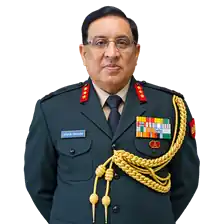
Lieutenant General Shokin Chauhan is a retired Indian Army officer whose career brings together command of major military formations, defence diplomacy and involvement in the management of peace processes. As Director General of the Assam Rifles, he led a security institution with a particularly important role in Northeast India. After retiring from the Army in 2018, he was appointed Chairman of the Ceasefire Monitoring Group.1,2
His subsequent work as a researcher and author has examined India's relations with Nepal and the place of its northeastern states within the wider regional environment. The connection between these interests and his military and diplomatic experience is visible in his published scholarship, which examines security in conjunction with political, historical and social conditions.1,8,9
Career at a glance
- December 1979
- Commissioned into 11 Gorkha Rifles
- 2004–2007
- Defence Attaché, Indian Embassy, Nepal
- 2015–2016
- Command of 1 Corps
- 2016–2018
- Director General, Assam Rifles
- August 2018
- Appointed Chairman, Ceasefire Monitoring Group
- 2024–2026
- Published books on India–Nepal relations and Act East Policy
Education and military formation
Chauhan attended St Columba’s School in New Delhi and subsequently the National Defence Academy. His professional education included the Defence Services Staff College, Army War College and National Defence College. He entered the Indian Army in December 1979 through the 11 Gorkha Rifles, an infantry regiment with a long military tradition.1,2,3
His academic training extended beyond the professional courses required for senior military responsibilities. He completed a doctorate at Panjab University, focusing on strategic relations between India and Nepal. The subject of his doctoral research was closely connected to his later published work and to an earlier diplomatic posting in Kathmandu.1
That combination of military education and academic inquiry offers a useful context for understanding his professional record. His career moved between assignments in operational formations and institutions concerned with diplomacy, regional security and political negotiations.
Command and military service
Chauhan served in a range of operational environments, including Jammu and Kashmir and Northeast India. His institutional biographies describe experience in counter-insurgency and counter-terrorism responsibilities, as well as command at brigade, division and corps levels.3,4
His appointments included command of a brigade and the 8 Mountain Division in Western Ladakh. He subsequently commanded 1 Corps, one of the Army's major formations. Command at these levels requires the administration of substantial military organisations and coordination of responsibilities across a range of subordinate units.3,8
The succession of these appointments is important to understanding the breadth of his experience before he became Director General of the Assam Rifles. His service background was not confined to one region or one institutional role, and his later writing reflects an interest in the relationship between operational responsibilities and the wider political environment.3,5
Defence diplomacy in Nepal
Chauhan served as India's Defence Attaché in Nepal between 2004 and 2007. This was a period of profound political transition in the country, marked by the end of the monarchy's direct rule and a peace process intended to bring its internal conflict to a conclusion. His appointment required him to represent India's defence interests during a changing bilateral and domestic political environment.2,4
Defence diplomacy differs from the leadership of a military formation. Its responsibilities include communication between military institutions and an appreciation of the political context in which defence cooperation takes place. Chauhan's years in Nepal subsequently became an important part of his intellectual engagement with the country.4,8
His doctorate and book on India–Nepal relations examine a relationship shaped by shared history and cross-border social and economic connections as well as questions of sovereignty and national security. The subject is particularly significant because the relationship cannot be explained through the conventional framework of interstate defence alone.1,8
Director General of the Assam Rifles
Chauhan led the Assam Rifles from 2016 until his retirement from the Army in March 2018. The force's responsibilities combine border and internal security functions in a region whose history, geography and social diversity give its institutional role particular complexity.2,3
During his tenure he was responsible for the leadership of an organisation with a substantial presence in Northeast India. His later research and public writing have returned to the significance of the region, including its relationship with Myanmar and the political conditions necessary for long-term stability.1,9
The Assam Rifles appointment connected his prior experience of military command with a broader engagement in regional affairs. The responsibilities involved in leading such a force differ in important respects from those of a conventional Army formation. In particular, the environment makes the relationship between security institutions and civilian communities central to the wider question of stability.
Ceasefire monitoring and peace processes
In August 2018, following retirement, Chauhan was appointed Chairman of the Ceasefire Monitoring Group for Nagaland and Northeast India. The appointment involved oversight of ceasefire arrangements and their agreed ground rules, as described in his institutional and publisher biographies.2,8
The management of a ceasefire is not the same as the negotiation of a final political settlement. It requires arrangements for communication and compliance while leaving larger questions of political reconciliation to the relevant parties and institutions. This distinction is an important theme in assessing the responsibilities of a monitoring group. His institutional biography at Indo-Pac Advisory describes his involvement in efforts to restore participation in the peace process; that assessment is attributed to the institution.5
Chauhan revisited the distinction between ceasefires and lasting peace in his November 2026 contribution to The Raisina Post. His essay considers the importance of political accommodation and the conditions necessary to sustain reconciliation beyond an agreement to suspend hostilities.
Military honours
Chauhan's recorded decorations are the Param Vishisht Seva Medal (PVSM), Ati Vishisht Seva Medal (AVSM), Yudh Seva Medal (YSM), Sena Medal (SM) and Vishisht Seva Medal (VSM). The PhD appearing with his professional credentials is an academic qualification, not a military decoration.1
The PVSM, AVSM and VSM are distinguished-service awards. The YSM recognises distinguished service in a war or conflict setting. The Sena Medal has categories that recognise gallantry or devotion to duty; without the original award citation this biography does not assign Chauhan's individual medal to either category.10
Scholarship and institutional work
Chauhan is listed as President of the Executive Council of CISA. He has also undertaken research associated with the Field Marshal KM Cariappa Chair of Excellence at the United Service Institution of India. The USI records a presentation in 2024 on the role of the Northeast's cultural and social resources in supporting stability and India's Act East Policy.1,6,7
This research considers how the region's connections with neighbouring countries can be understood in terms broader than security alone. His work on the subject has subsequently appeared in book form. The publisher describes Bridging Cultures as examining the relationship between security, economic institutions, education and cultural connections in the Northeast's engagement with Southeast Asia.9
His scholarship on Nepal and Northeast India, in combination with his published essays, offers readers an opportunity to examine how his earlier diplomatic and military assignments inform his treatment of contemporary public policy questions. His works remain available through their respective publishers and institutions.
Notable works
Bridging Borders: India–Nepal Relations in a Changing Geopolitical Landscape
A study of the historical, diplomatic and strategic foundations of India–Nepal relations. ISBN 9788196872274.
View publicationBridging Cultures: Northeast India’s Role in Furthering India’s Act East Policy
Examines the Northeast's regional connections, security and place within India's eastern engagement. ISBN 9788199772809.
View publicationThe Dynamics of the India–Nepal Relationship
A research publication examining the bilateral relationship from a strategic perspective.
View publicationBeyond Ceasefires: What Will Secure Lasting Peace in India’s Northeast?
An essay examining the conditions for peace beyond the maintenance of ceasefire arrangements.
View publicationReferences
- CISA — institutional biography
- Economic Council of India — professional biography
- Sakha Cultural Society — career and appointments
- HARS — military diplomacy and professional background
- Indo-Pac Advisory — professional biography
- USI — Field Marshal KM Cariappa Chair of Excellence
- USI — research presentation
- Pentagon Press — Bridging Borders
- Pentagon Press — Bridging Cultures
- Ministry of Defence — classification of military awards