
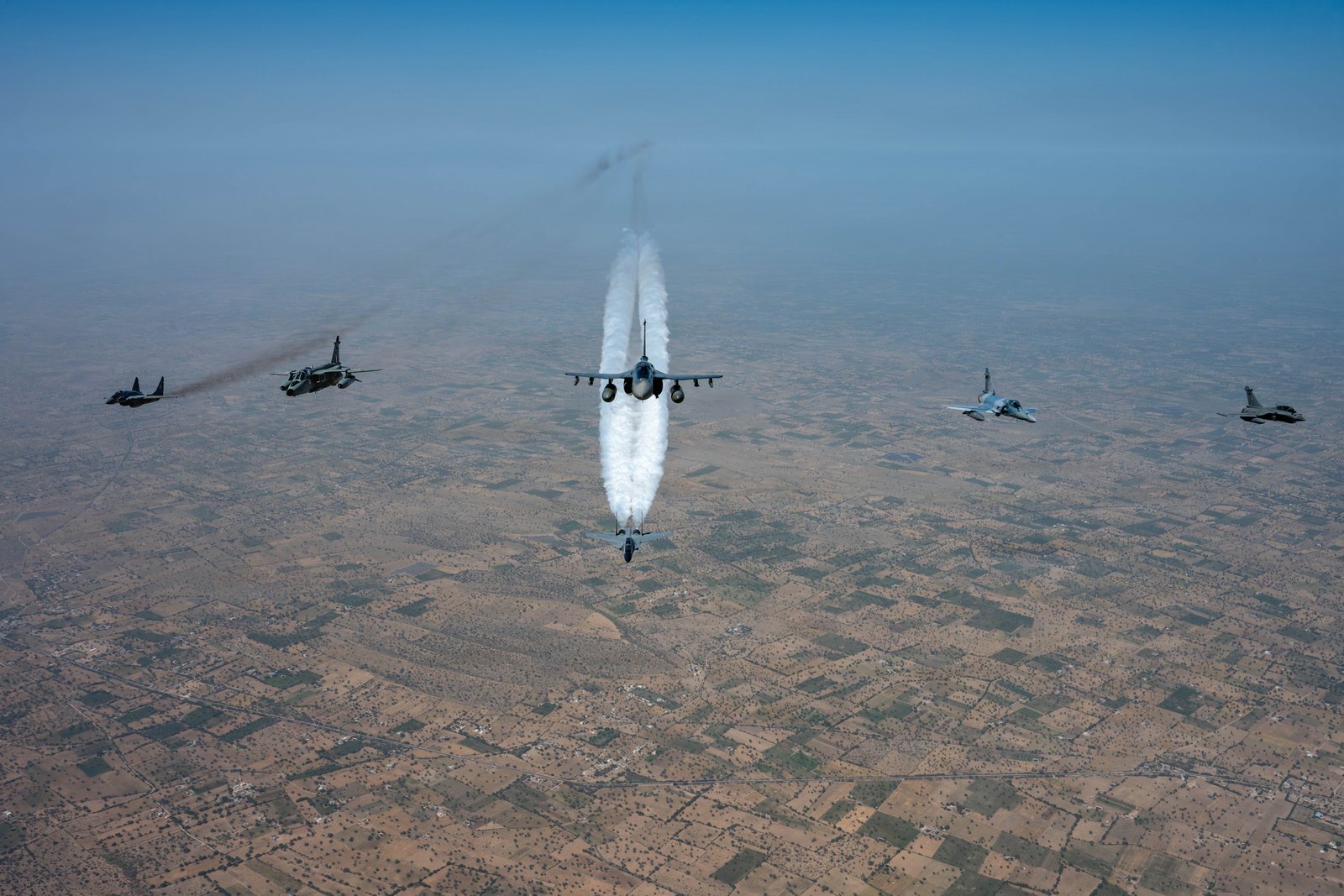
Air Marshal Anil Khosla, former Vice Chief of the Air Staff, examines India’s evolving airpower requirements and the need for an integrated and sustainable military capability.
Ready to listen
0%
India’s evolving security environment, characterised by the possibility of a collusive two-front challenge involving China and Pakistan, presents significant demands on the Indian Air Force (IAF). These demands are further complicated by the changing character of warfare, including the proliferation of unmanned aerial systems, precision weapons, cyber operations, space-based capabilities and multi-domain military operations.
India’s airpower preparedness must be assessed in terms of integrated combat capability rather than fighter squadron numbers alone. Six interrelated themes provide the framework for this assessment:
- India’s two-front airpower challenge
- Beyond fighter squadron numbers
- Integrated air defence
- Unmanned systems
- Jointness and integrated operations
- Deterrence
India’s Two-Front Airpower Challenge
The possibility of a two-front conflict involving China and Pakistan constitutes one of India’s most significant military planning challenges. The challenge is not merely the simultaneous employment of forces along two geographical fronts. It also involves the possibility of strategic coordination, intelligence sharing, military support and complementary pressure from both adversaries.12
The implications for the IAF are considerable. A two-front contingency would require the Air Force to spread its combat assets across two geographically separate areas, while retaining the ability to shift its focus to any emerging operational requirement. That in itself would place enormous pressure on the fighter force, AWACS, tankers, ISR assets, precision-strike capability, logistics and maintenance.
India’s two-front preparedness demands a force structure built around sustained operational capability, flexibility and resilience. That requirement must drive peacetime force planning, capability development, infrastructure and logistics rather than simply remain an exercise in contingency planning.
Building the Complete Airpower Ecosystem
Fighters are still the core of airpower. However, the environment in which they operate has changed substantially. The fighter is now part of a system that includes long-range weapons, UAVs, loitering munitions, airborne tankers and space-based ISR. A fighter simply cannot deliver its full potential on its own. Its effectiveness depends on the availability and integration of several supporting capabilities, including:35
- Force multipliers
- Intelligence and situational awareness
- Weapons and precision-strike capability
- Electronic warfare and network-centric operations
- Sustainment and operational endurance
The relevant measure of airpower should be the ability to generate, sustain and employ integrated combat effects rather than the number of combat aircraft alone.
Integrated Air Defence: Protecting the Airpower Ecosystem
The increasing complexity of the aerial threat has made an integrated air defence system an essential element of national security. An integrated air defence system (IADS) is an integrated system of sensors, command and control (C2) centres, communications and weapons designed to detect, track, engage and destroy aerial threats. Its essential components include:4
- Integrated detection and surveillance
- Command, control and communications
- Layered weapons architecture
- Electronic warfare
- Technological adaptation
India’s air defence architecture needs to evolve into a single, integrated, layered and resilient network incorporating surveillance, command and control, electronic warfare and a variety of interceptors.
Unmanned Systems: Expanding the Reach and Mass of Airpower
Unmanned systems are transforming the character of aerial warfare. Their growing use in surveillance, reconnaissance, targeting, electronic warfare and precision attack has expanded the range of missions that can be undertaken without exposing pilots to equivalent operational risks. These systems offer several operational advantages:3
- Persistent intelligence, surveillance and reconnaissance
- Target acquisition and battlefield monitoring
- Precision attack and loitering munition employment
- Electronic warfare and communications relay
- Decoys and deception
- Operations in high-risk or heavily defended environments
Manned-Unmanned Teaming. One of the most important developments is the loyal wingman concept. The underlying idea is to integrate crewed combat aircraft with multiple unmanned platforms, allowing each to perform complementary missions. A crewed aircraft could function as the command element, while accompanying unmanned systems undertake reconnaissance, electronic warfare, deception or weapons-delivery missions.
Swarm Technology and Affordable Mass. Drone swarms bring a new dimension to air warfare. Large numbers of relatively low-cost platforms can be used to saturate and deceive conventional defence systems and operate in a distributed manner. India therefore needs to develop the capability to operate unmanned systems while simultaneously developing the capability to counter them.
Unmanned systems should become an integral part of India’s future airpower architecture, contributing to surveillance, operational mass, persistence and combat flexibility.
Jointness: Integrating National Military Power
The effectiveness of airpower in a two-front conflict will depend significantly on its integration with the Army, Navy and other national security instruments. Jointness is therefore not merely an organisational issue. It is a fundamental requirement for the effective employment of national military power. However, there is an important distinction between deconfliction and genuine integration. India must move beyond simply ensuring that the services do not interfere with each other towards a system in which they plan, train and fight as a unified whole. This would require:6
- Common operational concepts
- Integrated planning
- Common C4I architecture
- Joint training and exercises
- Cultural transformation
Jointness requires a change in military culture, with officers developing an understanding of joint operations from the early stages of their careers. Airpower is, by its very nature, a centralised capability, as aircraft and other high-value assets have to be allocated across a number of competing operational requirements. It should not be viewed simply as a supporting capability for surface operations. Depending on the operational situation, it may support land and maritime forces, receive support from them or achieve independent strategic effects. India needs to develop a true joint operational concept in which airpower is a co-equal element of national military strategy, with central planning and coordinated execution across domains.
Deterrence: Converting Airpower Capability into Strategic Influence
The ultimate purpose of developing military capability is not simply to fight wars but to prevent them. Deterrence is one of the key functions of national military power in a nuclearised regional environment. Modern deterrence cannot be built on military power alone. It has to be a combination of diplomacy, information, military power and economic instruments as part of a whole-of-government approach. Airpower contributes to deterrence through several capabilities:78
- Ability to establish favourable air situations
- Precision-strike and long-range attack capabilities
- Effective intelligence and surveillance
- Rapid deployment and operational responsiveness
- Resilience against enemy air and missile attacks
- Ability to sustain operations under contested conditions
India’s airpower must contribute to a credible deterrence posture based on the ability to deny adversary objectives, impose costs when necessary and operate within a coherent national security strategy.
Recommendations
The six themes outlined above are not discrete capability development objectives. They are interrelated components of an integrated airpower strategy. IAF modernisation must be underpinned by an integrated capability development approach rather than a series of standalone platform acquisition programmes. The ability to sustain operations is just as important as the ability to launch them. Logistics, maintenance, indigenous production, technology acquisition, training and infrastructure are all equally important and must be given the same consideration as the acquisition of the platform itself.
Based on the above analysis and the strategic issues raised, the following are the key priorities:
- Restore and strengthen combat aircraft capacity.
- Accelerate force-multiplier acquisition.
- Develop integrated air defence.
- Expand unmanned capabilities.
- Strengthen joint operational integration.
- Improve operational resilience and endurance.
- Integrate deterrence into national security planning.
- Prioritise indigenous capability development.
Concluding Thoughts
India’s two-front airpower challenge is fundamentally a question of overall military readiness. The shrinking number of fighter squadrons represents a significant capability gap, but addressing that gap alone will not be sufficient to ensure the ability to conduct sustained and effective air operations against sophisticated and potentially cooperative adversaries. The future strength of Indian airpower will not be determined by fighter squadron numbers alone, but by the ability to integrate platforms, people, technology, networks and national military power into a cohesive and sustainable combat capability.
References
This paper is an analytical synthesis of selected writings published on Air Marshal Anil Khosla’s Air Marshal’s Perspective blog.
Author’s original references
- Anil Khosla. Future Conflict Scenario: Implications for IAF (Part 2). Article 73, 16 March 2021.
- Anil Khosla. India’s Air Power Amid Rising Geopolitical Challenges. Article 852, September 2026.
- Anil Khosla. Wings of Dominance: The Future of Air Warfare. Article 823.
- Anil Khosla. Integrated Air Defence Systems: Comprehensive Airspace Protection. Article 782, 23 January 2026.
- Anil Khosla. IAF Strategies: Past, Present and Future. Article 358, 26 June 2023.
- Anil Khosla. Jointness & Integrated Warfare. Discussion in How Does Air Power Shape Modern Warfare, 8 April 2026.
- Anil Khosla. Integrated Deterrence. Article 309, 19 November 2022.
- Anil Khosla. Deterrence in the Autonomous Warfare Scenario. Article 847, 4 September 2026.
Supplementary references — editorial research
Selected independently by The Raisina Post editorial desk for context; these are not presented as sources consulted by the author.
- SIPRI. Trends in International Arms Transfers, 2025. March 2026.
- Takshashila Institution. Limits of China-Pakistan Military Interoperability. 8 January 2026.
- PRS Legislative Research. Demand for Grants 2026–27 Analysis: Defence. 2026.
- Press Information Bureau. Operation Sindoor: The Rise of Aatmanirbhar Innovation in National Security. May 2025.
- Marcel Plichta, RUSI Journal. Precise Mass in Action: Assessing Ukraine’s One-Way Attack Drone Campaign. Volume 170, Issue 4, 2025; published abstract.
- Ministry of Defence. Chief of Defence Staff on indigenous UAVs and counter-unmanned aircraft systems. July 2025.
- Ministry of Defence. Joint Doctrine of the Indian Armed Forces, 2017. April 2017.
- Ministry of Defence. Joint Doctrines for Special Forces and Airborne & Heliborne Operations. 27 August 2025.
- Ministry of Defence. Operation Sindoor demonstrated tri-services synergy. 30 September 2025.
- Michael J. Mazarr, RAND. Understanding Deterrence. 2018.