
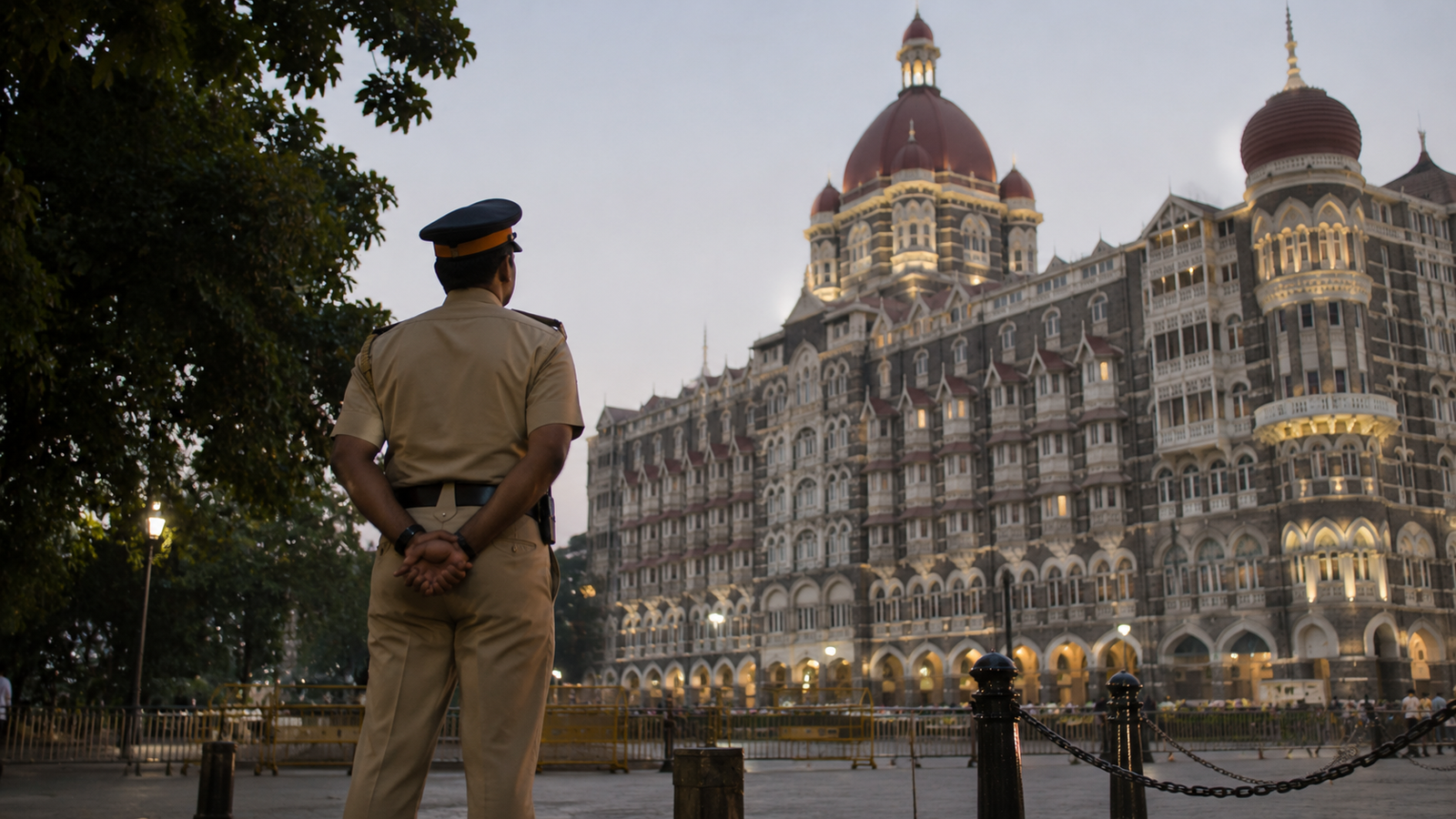
Eighteen years after the Mumbai terror attacks, a commemorative editorial dedicated to Mumbai Police, the fallen personnel and the families of every victim.
There are names in the records of the Mumbai Police which the passage of eighteen years has not made less significant. They belong to officers and constables who died in the discharge of their duties during the terrorist attacks of November 2008. Alongside them are the names of personnel from the railway police, the State Reserve Police Force, the Railway Protection Force, the Home Guards and the National Security Guard. Their institutions maintain records of their service. It is the responsibility of the country they served to remember them as individuals.123
On 26 November 2026, The Raisina Post dedicates this editorial to the Mumbai Police and to all those who lost their lives in the attacks. We remember the 166 people killed, including citizens of India and other countries, and acknowledge the lasting consequences for their families.6 No commemoration of the uniform can be complete without remembrance of the civilians it exists to protect.
The purpose of this edition is not to recreate the violence. It is to record the service of the men whose names appear in the memorial registers, to acknowledge the responsibility they carried, and to pay our respects to their families.
The responsibility of the uniform
Policing is a public undertaking exercised in the name of the law. The authority entrusted to a police officer comes with obligations towards citizens, including people the officer may never have met. Most of that work takes place without public notice. Its value is apparent in the freedom with which ordinary people are able to live their lives.
The events of November 2008 placed an extraordinary burden on public institutions whose personnel were called upon to protect civilians. In its statement to Parliament after the attacks, the government acknowledged the loss suffered by families and set out measures taken in response.7 The remembrance of individual service should sit alongside an institutional commitment to learn from that experience.
The rank held by a person is not a measure of the grief caused by his death. The roll that follows is therefore organised by surname rather than seniority, with the same editorial treatment for every individual.
The roll of honour
The Mumbai Police memorial register, the national gallantry citations and the Mumbai Railway Police register inform this roll. Where official English transliterations differ, variants are noted.123
Portraits: Mumbai Police official memorial register, reproduced with acknowledgement under its copyright policy. Images are hosted by the original source; if unavailable, the original portrait link remains.

Babasaheb (Balasaheb) Bhosale
Assistant Sub-Inspector
His name and rank are recorded in the Mumbai Police memorial register.1 The English rendering Balasaheb also appears in contemporary reporting.4

Arun Chitte
Police Constable
His name and rank are recorded in the Mumbai Police memorial register.1

M. C. Choudhary
Head Constable, Railway Protection Force
His name and rank are recorded in the Mumbai Police memorial register.1

Bapusaheb Durugade
Police Sub-Inspector
His name and rank are recorded in the Mumbai Police memorial register.1

Mukesh Jadhav
Home Guard
His name and rank are recorded in the Mumbai Police memorial register.1

Ashok Marutrao Kamte
Additional Commissioner of Police
His service was recognised with the posthumous Ashoka Chakra.2

Hemant Kamlakar Karkare
Joint Commissioner of Police and ATS Chief
His service was recognised with the posthumous Ashoka Chakra.2

Vijay Khandekar
Police Constable
His name and rank are recorded in the Mumbai Police memorial register.1

Prakash More
Police Sub-Inspector
His name and rank are recorded in the Mumbai Police memorial register.1

Tukaram Gopal Omble
Assistant Sub-Inspector
His service was recognised with the posthumous Ashoka Chakra.2

Jaywant Patil
Police Constable
His name and rank are recorded in the Mumbai Police memorial register.1

Yogesh Patil
Police Constable
His name and rank are recorded in the Mumbai Police memorial register.1

Ambadas Pawar
Police Constable
His name and rank are recorded in the Mumbai Police memorial register.1

Vijay Shahadev Salaskar
Police Inspector
His service was recognised with the posthumous Ashoka Chakra.2

Rahul Shinde
Constable, State Reserve Police Force
His name and rank are recorded in the Mumbai Police memorial register.1

Shashank Shinde
Police Inspector, Railway Police
The Mumbai Railway Police records his service and posthumous Kirti Chakra.3

Gajender Singh
Havildar, Indian Army / National Security Guard
His service was recognised with the posthumous Ashoka Chakra.2

Sandeep Unnikrishnan
Major, Indian Army / National Security Guard
His service was recognised with the posthumous Ashoka Chakra.2
Explore the memorial through source-linked questions about remembrance, service and gallantry.
The city and its people
In remembrance of every civilian victim
We honour every life lost, including those whose names are not individually recorded in this roll of service personnel. We remember their families and the lasting consequences of their loss.
The dead included people whose work brought them into contact with the public every day, as well as visitors and people going about private lives. Their deaths cannot be understood solely as a loss to institutions. Each was a loss to a family, and the consequences extended far beyond those present in Mumbai.
The same remembrance extends to the personnel who survived, to the medical and emergency services, and to the civilians who helped others. Their contributions need not be measured against one another. The act of helping a stranger in a moment of danger carries its own significance.
The attacks affected people from several countries. Remembering them requires a recognition of the common humanity that terrorism seeks to disregard. The proper response to their loss is a commitment to protect human life and to uphold the law, without assigning collective blame to communities.
The duty that remains
Remembrance is also an institutional responsibility. In 2020, the Police Martyrs’ Gallery opened on the anniversary of the attacks, preserving the records of police personnel who had died in service across Maharashtra. Families of fallen officers were associated with its inauguration.8 Such records matter because remembrance must extend beyond those whose names are already familiar to the public.
The obligations of the state to serving personnel do not end with a memorial. Training, welfare, institutional preparedness and sustained care for bereaved families are part of the public responsibility that accompanies the honour accorded to service. These are obligations that must be exercised in ordinary years as well as on anniversaries.
To the families who have carried this loss for eighteen years, we offer our respects. To the personnel of the Mumbai Police and the other services who continue to discharge their responsibilities, we acknowledge the importance of the work entrusted to them.
May the names of those who died in the service of others remain a permanent part of our public memory.
The Raisina Post pays its respects.