
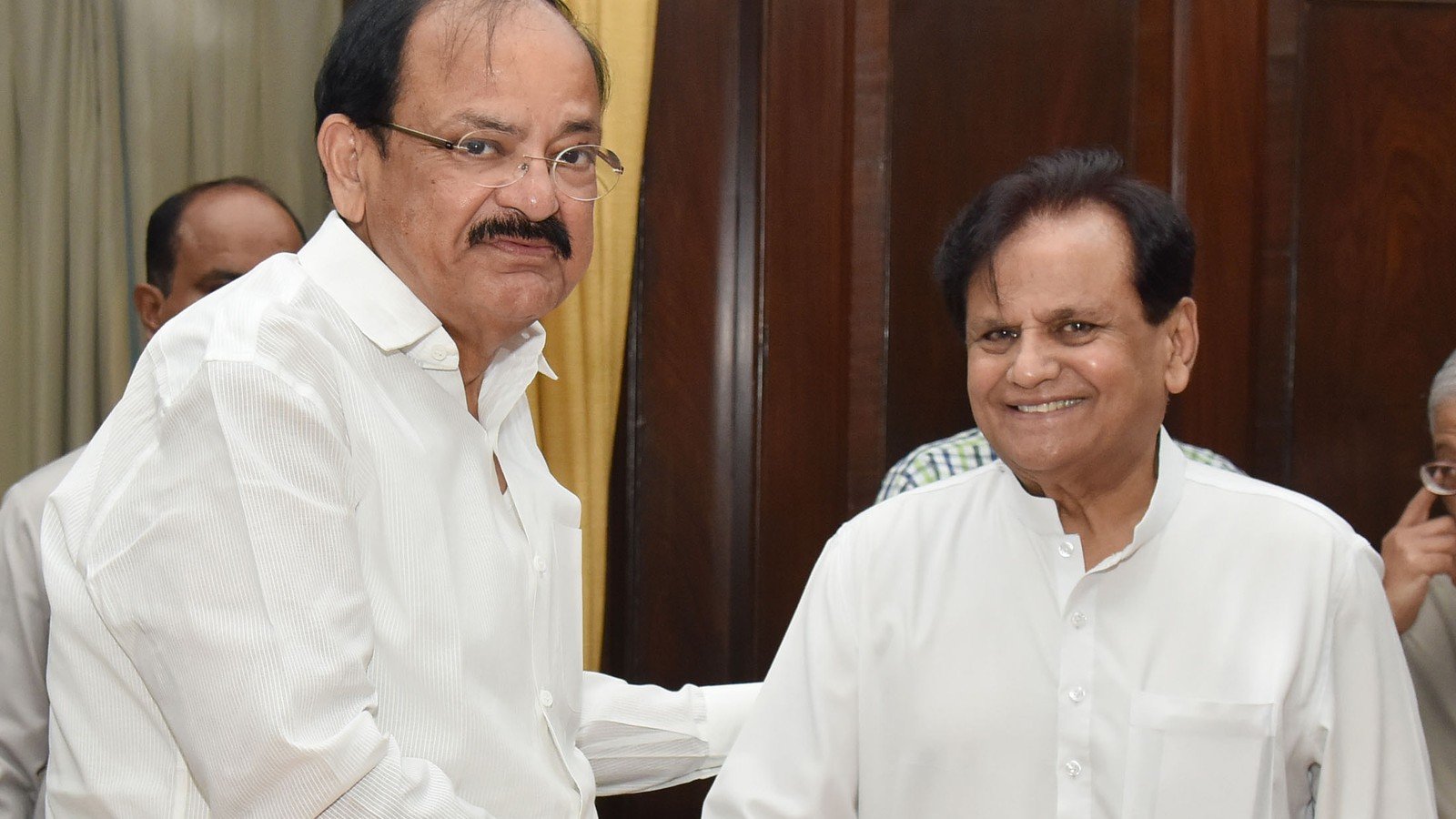
For four decades, Ahmed Patel worked at the centre of a changing Congress. Six years after his death, his career offers a history of how India’s coalition governments were built, and of the limits of political influence exercised away from public office.
Ready to listen
0%
Four decades at the heart of Congress politics
39
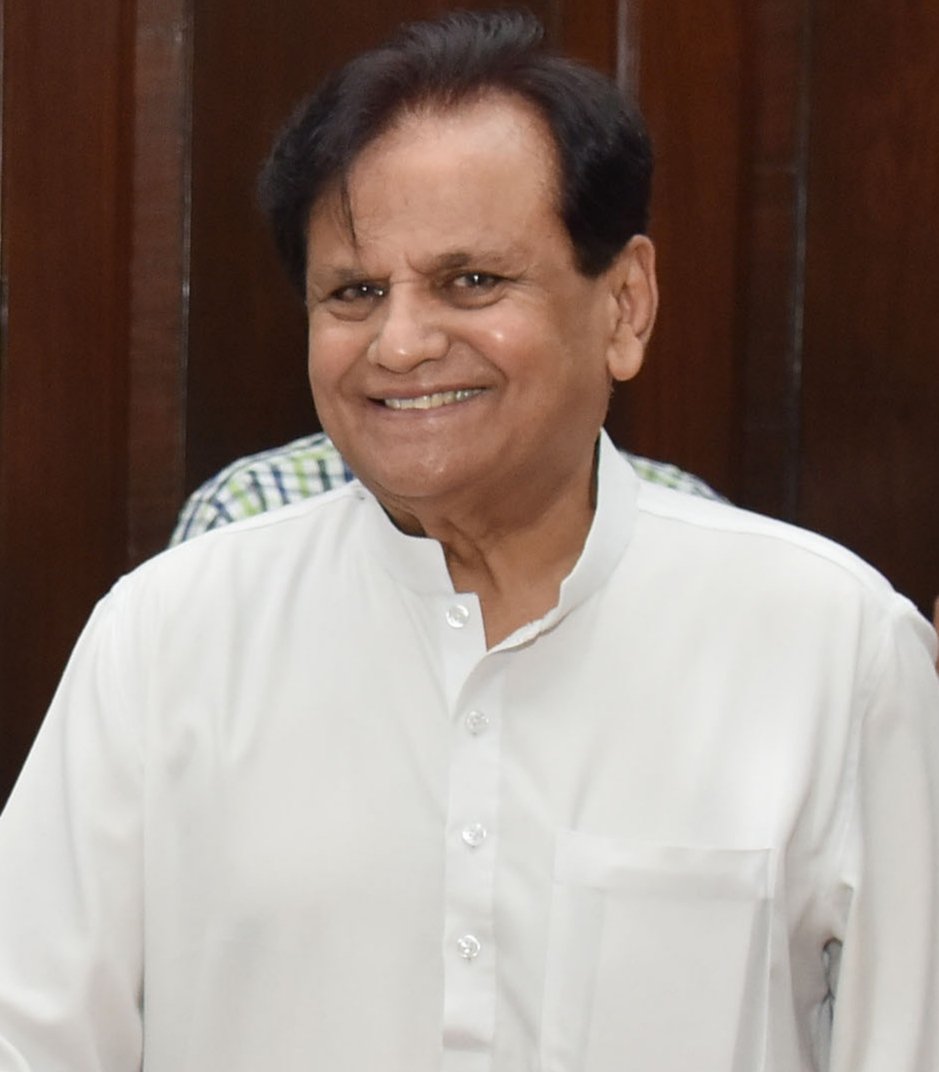
Vice President’s Secretariat / PIB. Original photograph · GODL-India.
Ahmed Patel entered Parliament in 1977, representing Bharuch in Gujarat. Over the next four decades, he served three terms in the Lok Sabha and five in the Rajya Sabha, working with successive generations of Congress leaders. His career offers a view of Indian politics from within the party organisation, particularly of the negotiations and relationships that sustained the coalition governments of the United Progressive Alliance. He never served as a Union minister, choosing instead to work primarily within the Congress organisation. 7911
One of the most closely watched contests of his parliamentary career came in August 2017. With Congress in opposition nationally and facing defections in Gujarat, Patel sought another term in the Rajya Sabha. Representatives of Congress and the Bharatiya Janata Party (BJP) presented opposing arguments to the Election Commission over the validity of two ballots. The commission’s decision would determine the result. 127
The commission ruled that the two ballots should be excluded because the legislators concerned had breached the rules governing the secrecy of the vote. The number required to win fell to 44. Patel received precisely that number. Amit Shah, then the BJP president, and Smriti Irani won the other two seats. The BJP challenged the outcome, which later became the subject of litigation. 11327
 Open archival photograph on Wikimedia Commons
The election was a reminder of how much the political landscape had changed since Patel first worked alongside Sonia Gandhi in the years leading to the formation of Congress-led governments. In 2017, the party faced a different set of organisational and electoral challenges. Retaining his parliamentary seat was an important result for the Congress in Gujarat.
The political changes he witnessed were considerable: the defeat of Indira Gandhi after the Emergency, the extraordinary majority won by Rajiv Gandhi in 1984, the rise of regional parties, the coalition governments of Manmohan Singh and the return of single-party majority government in 2014. 7911
To understand his place in this history, it is worth returning to Bharuch, where his parliamentary career began.
One reason the election commanded so much attention was the identity of the BJP's third candidate. Balwantsinh Rajput, who had previously been a Congress legislator, was competing for the seat Patel sought to retain. The election was therefore a contest over the allegiance of legislators already elected to the Gujarat assembly, rather than an opportunity for either party to seek a fresh mandate from the electorate. For the Congress, defections from its existing ranks had become an immediate threat to its representation in Delhi.154
The dispute also brought into view politicians who rarely received comparable national attention. After the result, Gujarat Congress leader Arjun Modhwadia said that 43 Congress legislators had supported Patel and that the remaining vote came from Chhotubhai Vasava, the lone Janata Dal (United) legislator in the state. That was Congress's account of the voting, not an independently established reconstruction of every ballot. It nonetheless illustrates how, in an election decided by a narrow margin, the position of a single legislator from a smaller party could acquire national importance.49
The Election Commission's order is a particularly useful document for understanding the episode. The question before it was whether the disputed ballots had been shown to people not authorised to see them under the procedure for Rajya Sabha elections. The decision concerned the validity of votes under election rules, rather than the commission's assessment of either candidate's political merits. In that distinction lies an important part of the story: the contest was ultimately resolved through a formal electoral institution.48
1977–1993 | The road from Bharuch
Ahmed Patel was born on 21 August 1949 in Piraman, in Gujarat’s Bharuch district. His early political experience came through local government. In 1977, he stood for the Lok Sabha in Bharuch as a Congress candidate, at a time when the party was facing widespread public anger over the Emergency. Indira Gandhi lost the election nationally and the Janata Party took office. Patel, however, won his constituency. 710

He retained Bharuch in 1980, when Indira Gandhi returned to power, and again in 1984, after her assassination. Rajiv Gandhi’s arrival in office opened a different phase in Patel’s career. He became one of the prime minister’s parliamentary secretaries and held positions in the All India Congress Committee (AICC), giving him experience of the national organisation as well as electoral politics. 79
 Open archival photograph on Wikimedia Commons
The 1980s also brought changes to the political landscape of Gujarat. The BJP grew in strength and Congress’s position in several of its former strongholds deteriorated. Patel lost Bharuch in 1989. He entered the Rajya Sabha in 1993, beginning a period of parliamentary service that continued until his death. 89
The changing fortunes of his constituency can be traced in reports published at the time. During a by-election in Bharuch in November 1998, Rediff described the BJP’s efforts to protect a seat it had held since 1989. Its report noted how the party’s vote share there had fluctuated over the preceding elections. Patel, already a member of the Rajya Sabha, was still campaigning in the district. Twenty years later, the possibility of his return as a Lok Sabha candidate was again being discussed within Congress. 1932
His career in Delhi increasingly followed a different course from his party’s fortunes in Gujarat. A politician who had begun with direct electoral mandates became better known for his knowledge of Congress’s state units and his relationships with its leadership. This was also the period in which national politics became more dependent on negotiations among parties. The dominance Congress had once enjoyed in Parliament was giving way to minority and coalition governments.
In Delhi, Patel had acquired experience within an organisation whose internal arrangements were themselves changing. At the Congress plenary session in Tirupati in 1992, P V Narasimha Rao allowed elections to the Congress Working Committee. Among the candidates who secured election were Patel, Pranab Mukherjee, Sharad Pawar, Arjun Singh and Ghulam Nabi Azad. Their careers would take different directions over the next three decades. The episode places Patel within a generation of Congress politicians who had developed political standing of their own, even while working within a party closely associated with the Nehru-Gandhi family.44
The Working Committee mattered because it brought the senior leadership of the party into a common forum. Its members were not necessarily holders of government office, and their disagreements were often as consequential for a Congress administration as debates in Parliament. Patel's progression from a constituency representative to a member of that body was a significant change in the kind of responsibilities he undertook. It was also a reminder that the Congress of the early 1990s contained several rival centres of political authority. Its later concentration around Sonia Gandhi was not an inevitable continuation of the preceding arrangement.447
1996–2004 | Inside the Congress leadership
The years following Rajiv Gandhi’s assassination in 1991 were difficult for Congress. P V Narasimha Rao became prime minister, but the party lost the 1996 election. Sitaram Kesri succeeded Rao as party president. Patel was appointed treasurer of the AICC in 1996, a position he retained when Sonia Gandhi took over the party in 1998. His association with the Gandhi family was important, but his organisational experience had also been accumulated under other Congress leaders. 72434
His rise was not without reversals. A report published by India Today in July 2000 described disagreements within the Gujarat Congress, including tensions involving Madhavsinh Solanki, which had contributed to Patel’s departure as treasurer. The episode is a reminder that the man later credited with resolving disputes had himself been caught up in them. 20
In 2001, Sonia Gandhi appointed him her political secretary. The position placed him at the centre of the party presidency, where the concerns of state leaders, senior MPs and other party officials had to be reconciled. It carried no authority to make government decisions. Its importance depended on his access to Gandhi and on the confidence of people who needed to reach her. 711
The general election of 2004 transformed the significance of that role. Congress won 145 Lok Sabha seats and the BJP 138. Neither had enough seats to govern alone. The new United Progressive Alliance (UPA) depended on regional allies and outside parliamentary support, including that of the Left parties. 1011
Sonia Gandhi decided not to become prime minister and Manmohan Singh took office. The leadership of the government and that of the main governing party were now held by different people. Decisions about policy, appointments and the management of the coalition could require consultation beyond the cabinet. Reports from the period and retrospective accounts describe Patel as an important intermediary in that arrangement. 11221
It was a kind of influence that could be difficult to measure. His name was not attached to the decisions of the cabinet and the details of many discussions remained private. But his position gave him access to both the party leadership and the political figures on whose cooperation the government depended.
Gujarat offered an early indication of the problems Congress would encounter as a party no longer able to govern by itself. Shankersinh Vaghela had broken with the BJP and led a government dependent on Congress support. A contemporary India Today report from August 1997 recorded Patel's election to the Working Committee at the Calcutta plenary and his opposition, alongside Madhavsinh Solanki, to continuing the existing arrangement. For the Congress leadership, the difficulty was deciding whether support for another party's government would preserve its influence or further weaken its own political identity in the state.45
Dilip Parikh succeeded Vaghela as chief minister later that year. The political difficulties did not end with the change of leadership. A Rediff report in February 1998 described fresh discussions about electoral cooperation, involving Patel and Parikh, which had failed to produce agreement. This was an earlier and less successful example of the kind of negotiation with which Patel would later be associated at the national level. Even when party representatives could agree on the desirability of preventing a rival from taking power, they still had to reconcile conflicting interests in the constituencies where they sought votes.46
A report in the Times of India published in March 2004, before the general election that brought the Congress back to government, described Patel's importance to aspiring Congress candidates in Gujarat and his place on the party's Central Election Committee. The account was written in anticipation of an election, rather than in the retrospective atmosphere that followed his death. It gives a useful indication of the authority he had accumulated even while Congress was in opposition. Access to the national leadership mattered because candidates and state officials required decisions on questions that local units could not settle alone.47
2004–2014 | The years of coalition government
The most serious parliamentary test of the first UPA government came in 2008. Manmohan Singh had negotiated a civil nuclear agreement with the United States, which the Left parties opposed. Their withdrawal of support threatened the government’s majority. The disagreement over foreign policy had become a question of whether Singh would remain in office. 1226
By early July, the Samajwadi Party was moving towards supporting the nuclear agreement. On 22 July, the government won a confidence vote in the Lok Sabha by 275 votes to 256. Patel was among the Congress officials associated with efforts to secure the necessary support. The result depended, however, on the decisions of several party leaders and their MPs, not on any one individual. 112633
 Open archival photograph on Wikimedia Commons
The proceedings were overshadowed by allegations that MPs had been offered money. Three BJP members displayed bundles of currency in the chamber, and the BJP subsequently alleged that Patel was involved. A parliamentary committee reported in December 2008 that it had found no evidence against him on the charge of offering bribes. The allegation and the committee’s finding both form part of the historical record. 26
Patel later identified the nuclear agreement as one of the difficult episodes of his time working with Sonia Gandhi. In a December 2017 interview with Sheela Bhatt, he also recalled the circumstances surrounding Gandhi’s decision not to become prime minister in 2004. He did not disclose what he had advised her at the time. The interview provides an account of the pressures he faced, while leaving the contents of private discussions uncertain. 23
Congress improved its electoral position in 2009, winning 206 Lok Sabha seats, but still needed allies to govern. Patel continued to serve as Gandhi’s political secretary during the second UPA government. By then his influence had attracted considerable attention from journalists, including those who questioned the degree of power exercised by someone outside the government. 101121
A profile published by The Caravan in 2011 examined Patel’s role in the distribution of influence within the Congress and its relationship with the UPA administration. Written while the government was still in office, it offers a different perspective from the tributes that appeared after his death. The question it raises is one that extends beyond Patel: how should voters assess political authority when some of the people involved in shaping decisions hold no executive office? 21
Patel himself addressed the question of why he had not become a minister in an April 2018 interview with Smita Gupta at The Hindu Centre. Asked about offers of ministerial office during the tenures of Rajiv Gandhi and Manmohan Singh, he said that he believed the party offered a more enduring means of public service than a government or ministry. His answer also reflected his understanding of the Congress as an organisation that would continue to exist after any individual government left office. 5
The election of 2014 put that belief to the test.
The separation between party and government had consequences beyond the question of who would become prime minister. A Congress politician seeking a decision on an organisational matter had to address the party leadership; a minister seeking to pursue government policy operated through an executive structure answerable to Parliament. Under the UPA, those spheres intersected whenever a policy decision depended on the cooperation of parties outside Congress. The political secretary's work was situated at that intersection. Yet he had no power to replace the legal or constitutional processes through which those decisions were made.221
Patel described his understanding of the position in an interview with Sheela Bhatt during the 2012 Gujarat assembly election campaign. He distinguished coordinating the work of the party from acting as an adviser responsible for its political choices. At the direction of the party president, he said, the coordination could extend to relations between Congress and the government. It is an important distinction in his own account of the office. It does not resolve every question raised by independent reporting about his influence, but it sets out the remit that Patel himself acknowledged publicly.4
The contrasting assessments matter particularly in retrospect. Journalists who covered Congress in government sometimes described access to its president as an important source of authority. Patel, however, presented the work as an organisational function that facilitated communication. Both accounts can be consistent with a political secretary exercising substantial influence without independently deciding government policy. The evidence of a particular meeting or negotiation should not be taken to establish more than it actually records. The existence of private consultation is not proof that its participants agreed on every question under discussion.214
The decade in government also left the party with an enduring problem. Writing after Patel's death, a commentator in The Indian Express reflected on Congress's failure to strengthen its organisation in the states during the years when it held national office. The question was not simply why the coalition had eventually lost power, but why a decade of incumbency had not produced a stronger electoral base. The capacity to keep a government together and the capacity to renew a party's support among voters are different achievements. The first can create opportunities for the second; it cannot guarantee it.53
2014–2018 | A party out of power
Congress fell from 206 Lok Sabha seats to 44 in May 2014. The BJP won 282, obtaining a parliamentary majority of its own. For the first time in three decades, a single party could form a government without depending on coalition partners for its majority. The political conditions in which Patel had exercised much of his influence had changed. 10
Congress was also facing a question of succession. Rahul Gandhi’s growing role had been discussed publicly for years. Patel had already acknowledged his prominence in an interview during the Gujarat election campaign of 2012. Reporting in 2015 considered how the relationship between the two generations of the party leadership might affect Patel’s role. Rahul Gandhi eventually became Congress president in December 2017. 42223
Before that transition, the Rajya Sabha election in Gujarat exposed the scale of the party’s difficulties in the state. Shankersinh Vaghela had left Congress, and several party legislators had defected. The contest for Patel’s seat was determined by the Election Commission’s decision on two ballots, rather than by any revival in the party’s electoral strength. He returned to Parliament, but Congress remained in opposition in Gujarat. 127
On 21 August 2018, his 69th birthday, Patel was appointed Congress treasurer, replacing Motilal Vora. It was the same office he had relinquished eighteen years earlier. Contemporary reporting linked the appointment to the financial pressures facing the party ahead of the 2019 election. Congress no longer had the advantages of national incumbency, and the BJP had established a formidable electoral organisation. 2425
The task was different from managing the UPA. A party could negotiate with allies and resolve disputes among its senior politicians without necessarily winning back its voters. Patel acknowledged some of the difficulties in his 2018 interview. He discussed the need for local organisation and better work at polling-booth level, and recognised that the BJP’s booth management was stronger. His own account was more candid about Congress’s weaknesses than some of the later portrayals of his political abilities. 5
The following year’s general election again returned the BJP to power with a majority, and Congress increased its Lok Sabha tally only to 52. But even in defeat, circumstances arose in which Patel’s experience of coalition politics remained relevant. 1018
Rahul Gandhi's appointment of Patel as treasurer in 2018 was one of a number of changes to the senior organisation. Motilal Vora moved to a newly created administrative position. The decision showed that Patel's career did not end with the departure of Sonia Gandhi from the presidency in December 2017. But it also changed his formal responsibilities. Reporting at the time identified the party's finances as a pressing concern, as Congress prepared to fight a general election from opposition. The appointment brought back a man who had occupied the same office during an earlier period out of government.245052
The change invites a distinction between two kinds of political continuity. An organisation can retain an experienced official because his knowledge is useful, without reproducing the circumstances that originally gave him influence. Patel's old position was associated with Sonia Gandhi's presidency and with the structure of coalition government. By 2018, neither existed in the same form. A new generation was leading Congress, and the party had to establish a basis for recovering support in an electoral environment that had changed markedly since 2004.525
2019–2020 | The final negotiations
In Maharashtra, the 2019 assembly election produced a breakdown in the longstanding alliance between the BJP and the Shiv Sena. The possibility emerged of a government formed by the Sena, the Nationalist Congress Party (NCP) and Congress — parties whose histories and political positions made cooperation far from straightforward. 2829
Reports in November recorded Patel’s participation in the discussions involving Sharad Pawar’s NCP and his meeting with Uddhav Thackeray. The negotiations addressed how the parties might govern together and the principles of a common programme. The arrangement ultimately produced the Maha Vikas Aghadi government. Patel was one of the senior participants, alongside the leaders of the three parties. 142829
 Open archival photograph on Wikimedia Commons
The negotiations illustrated a familiar feature of coalition politics. To reach an agreement, the parties needed to find enough common ground to govern while retaining their separate identities. The government was not a permanent resolution of their disagreements, and its creation cannot be attributed to a single negotiator.
The following year, Congress faced another crisis, this time in Rajasthan, where a dispute between Chief Minister Ashok Gehlot and Sachin Pilot put the state government under pressure. Patel participated in attempts to resolve the dispute and was named to a committee dealing with the grievances of the dissident group. 15
But difficulties were mounting within the national organisation itself. In August 2020, a group of 23 senior Congress leaders wrote to Sonia Gandhi calling for changes in the party’s organisation, including more effective leadership and greater collective decision-making. These concerns were not limited to a single dispute or state. They went to the heart of how Congress was run. 16
Patel died on 25 November 2020, aged 71, after contracting Covid-19. His death came at a time when the party was facing questions about both its electoral future and its leadership. Among those who publicly acknowledged his contribution to Congress was Prime Minister Narendra Modi, a political opponent from the same state. 930
How Sonia Gandhi remembered him
In November 2026, a fortnight before the sixth anniversary of Patel’s death, Sonia Gandhi published Belonging: A Journey of Love. According to reports quoting Chapter 29, page 401, Gandhi recalls the reach of Patel’s political influence and his willingness to take a hard line against those who challenged him. In recalling his death, she described the loss as “a vacuum in the party and an absence I felt personally”.636 The published account mistakenly gives 2022 as the year of his death; he died on 25 November 2020.9
Speaking to ANI on 10 November 2026, his daughter Mumtaz Patel said the account captured her father accurately. In particular, she understood his firmness in the context of his commitment to the party and its leadership. Her remarks were made publicly following the memoir’s release, not in an interview with The Raisina Post.37
In the months before Patel's death, Congress had to deal with questions that could not be addressed through state-level agreements alone. The debate over its leadership and internal decision-making exposed differences about the future of the organisation itself. In that respect, the Rajasthan dispute and the letter from senior leaders were distinct problems, although both occurred in the same year. Resolving the immediate threat to a state government did not settle the wider argument about how the national party should be governed.1516
Sonia Gandhi's later recollection is worth reading alongside Patel's own interviews and the reporting of the period. The memoir offers the account of someone who worked closely with him for many years. It is a personal source with the value, and the limitations, that implies. It helps explain how she viewed his political judgment and the relationship between them; it does not independently establish what happened in every negotiation in which he took part. In a career so often described through private conversations, keeping these kinds of evidence separate is essential.645
The other side of his parliamentary career

Accounts of Patel frequently focus on his proximity to the Gandhi family. Less often discussed is his work as an elected representative. His parliamentary record, compiled by PRS Legislative Research, includes interventions concerning the textile industry after the introduction of the Goods and Services Tax, the condition of sanitation workers, water in the Narmada and Indian fishermen held in Pakistan. 3
During the pandemic in 2020, he raised concerns about access to oxygen cylinders, the difficulties faced by students and the position of workers owed payments by Bharat Sanchar Nigam Limited. His private members’ bills addressed issues including the circumstances of farmers in arid regions, salt workers and adolescent girls. These proposals did not become law, but they show the range of issues he chose to raise as a parliamentarian. 3
The record offers another way of looking at a career often described in terms of relationships behind closed doors. Parliamentary questions and bills are public documents. They provide evidence of what he placed before the legislature, separate from the less accessible history of his work inside the party.
The parliamentary record is important for another reason. It brings the Gujarat politician back into view. The subjects of his questions cannot be reduced to the affairs of Congress's leadership in Delhi. When he raised matters such as the difficulties of textile workers or fishermen detained abroad, he was using the same public institution to which he had first been elected in 1977. The record does not show that all his interventions produced the outcomes he sought. It does, however, provide a documentary account of concerns that otherwise receive little attention in histories dominated by the survival of governments.3
Bharuch after Ahmed Patel
In February 2024, Congress agreed to leave Bharuch to the Aam Aadmi Party under an opposition seat-sharing arrangement. The decision provoked objections within the local Congress organisation, including among members of Patel’s family. At the general election, the BJP retained the constituency. 3135
The episode returned the question of coalition politics to the district where Patel’s career had begun. A decision taken as part of a national alliance could be difficult for a local organisation that had maintained its own political identity over decades. It is not possible to establish how Patel would have approached the decision had he been alive.
At the national level, Congress’s fortunes did not follow the most pessimistic predictions made after his death. Mallikarjun Kharge was elected party president in 2022 after a contest with Shashi Tharoor, and the party won 99 Lok Sabha seats in 2024. These developments do not settle the question of its long-term strength, but they caution against treating its future as dependent on one individual. 1718
Patel’s political life began with a victory in Bharuch at a moment of national defeat for Congress. Four decades later, the party had to mount a determined effort to retain his seat in the Rajya Sabha. Between those elections, he helped an organisation accustomed to governing alone adapt to a period in which it could govern only by working with others.
His career also exposed the difficulties of judging political influence that is exercised outside the cabinet. Some of his work is documented in elections, parliamentary records and interviews. Other parts survive primarily in accounts by colleagues, political opponents and journalists. There is a limit to what those accounts can establish about individual decisions.
Six years after his death, the question raised by his career is not whether another politician can reproduce his relationships. It is whether parties can develop lasting ways of negotiating and resolving internal differences, without relying on a single person to do so.
The long electoral history of Bharuch supplies a useful corrective to accounts that place every turning point in the capital. The constituency had elected Congress representatives for much of the period before Patel's defeat in 1989. Chandu Deshmukh then won successive elections on a BJP ticket, and Mansukh Vasava subsequently became its long-serving representative. By 2024, the principal challenger to the BJP in the seat was no longer standing as a Congress candidate. The evolution of this one constituency captures a shift in party competition that began long before the formation of the UPA.5131
There is a broader historical lesson in the contrast. Patel belonged to a generation whose political careers extended from the period of Congress dominance into the era of coalition government and then into the emergence of a new majority party. The changes were neither uniform across India nor wholly attributable to national leaders. In Gujarat, the transformation of constituency politics had begun while Congress was still a leading force nationally. A political career that straddled those different settings cannot be understood solely through the relationships its subject maintained in Delhi.5153
Editorial references
Selected records used in this retrospective. Other reporting and archival material can be reached through the linked superscripts in the text and photograph credits. Sonia Gandhi’s memoir is cited through published excerpts.
- The Indian Express — Gujarat Rajya Sabha election results, 9 August 2017.
- Indian National Congress — Party tribute to Ahmed Patel.
- PRS Legislative Research — Ahmed Patel: parliamentary activity.
- Rediff / Sheela Bhatt — Interview with Ahmed Patel, December 2012.
- The Hindu Centre / Smita Gupta — Interview with Ahmed Patel, 18 April 2018.
- India Today. Sonia Gandhi’s memoir: Ahmed Patel and the incorrect death year, 10 November 2026