
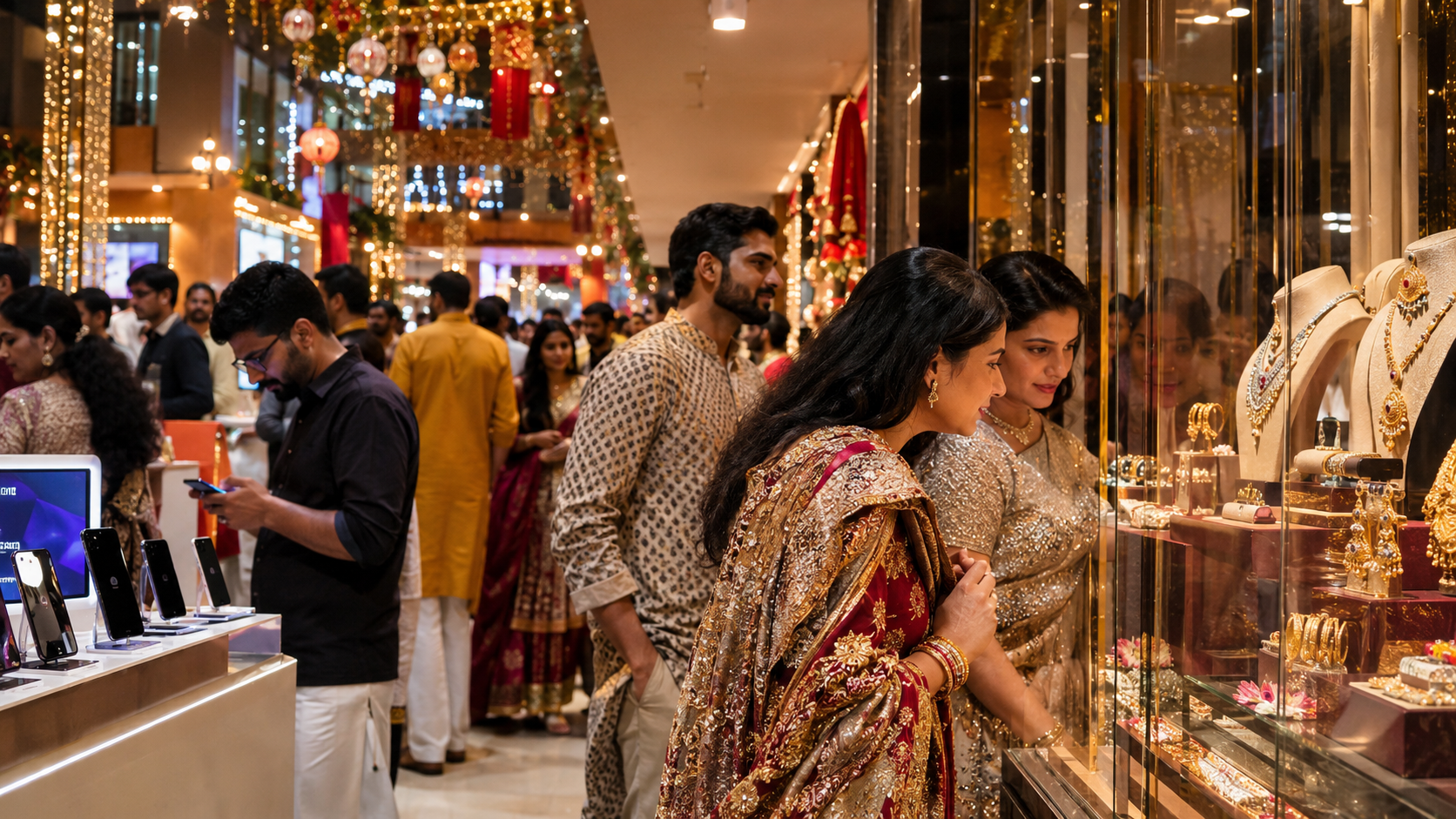
Indian households are going into Diwali with the same festive intent but tighter wallets. A LocalCircles survey estimates urban festive spending will fall 6% this year to ₹1.97 lakh crore,2 while the Confederation of All India Traders (CAIT) projects festive trade above ₹7 lakh crore, growth of 15–18%.3 The two forecasts are less contradictory than they look. Rising prices lift the rupee value of what is sold, while shoppers buy fewer grams of gold, fewer phones and cheaper baskets.
Diwali falls on Sunday, 8 November, with Dhanteras, the traditional gold-buying day, on Friday, 6 November.1 Here is what the data shows is going into shopping bags, and what it means for household budgets and the companies that sell to them.
Budgets are squeezed, but intent holds
LocalCircles’ Mood of the Consumer 2026 survey, which drew more than 67,000 responses from 307 districts, puts the average household festive budget near ₹20,000. About 57% of urban households plan discretionary purchases, while 31% plan none. Among those planning to spend, 83% expect to use savings to fund at least part of the bill.2
Prices explain much of the caution. Retail inflation rose to 5.54% in September, with food inflation at 7.74%.2 The Reserve Bank of India raised the repo rate by 25 basis points to 5.50% on 7 October, its first increase in more than three years, and shifted its stance to “calibrated tightening”.6,7 The central bank expects inflation to peak near 6% in the October–December quarter, which is the festive quarter.2
The RBI’s own September survey of 6,054 urban respondents across 19 cities found 90.1% reporting higher spending on essentials than a year earlier.4 Some 54.5% said the general economic situation had worsened.5 Households’ median one-year inflation expectation reached 10% in September, up from 8.6% earlier in 2026.8
Clothing leads the list, jewellery trails
New clothes remain the festival’s default purchase. In the LocalCircles survey, 72% of households planning festive purchases expect to buy clothing, footwear and accessories, the most popular category. Home appliances and furniture, and travel, were each cited by 45%. Gourmet food and gifting drew 39%, phones and consumer electronics 22%, and jewellery just 6%.2
Value retailers are collecting the spend. Trent, which owns Westside and Zudio, reported standalone revenue up 23% to ₹5,788 crore in the September quarter and opened its 1,000th Zudio store.9
Gold: higher bills, fewer grams
Gold is the clearest example of rupees rising faster than tonnes. Domestic prices were around ₹1,41,500 per 10 grams in early November, roughly 25% below the January peak of more than ₹1.80 lakh, according to Ventura’s NS Ramaswamy.11 That is still expensive.
The World Gold Council (WGC) said India’s gold demand fell 29% year-on-year to 162.5 tonnes in the July–September quarter. Jewellery demand dropped 20% to 99.9 tonnes, though its value rose 16% to ₹1,48,700 crore. The council expects 625–675 tonnes for the full year.10 Over the first nine months, volumes fell 12% to 444 tonnes while value rose 38% to ₹6.69 trillion. Bar and coin demand was down 40% in the quarter.11
The listed jewellers show the same pattern. Titan’s domestic jewellery business grew about 21% in the September quarter on mid-single-digit buyer growth and double-digit growth in average ticket size. The company said the festive calendar had shifted into the December quarter.12 In other words, price is flattering revenue more than footfall is.
For Dhanteras, jewellers expect volumes to stay near last year’s level while sales value rises 15–30%. Gem & Jewellery Council Vice Chairman Avinash Gupta put the expected value growth at 15–20%.13 Old-gold exchange has surged, which has improved domestic supply and kept local premiums in check.11 Fund managers quoted by Business Standard advise staggered buying through gold or silver ETFs instead of a single lump sum.11
Phones: the biggest online ticket, and the most price-sensitive
Online platforms opened the festive season with a sprint. Redseer estimates e-commerce companies sold about ₹24,000 crore of goods in the first two days across 8–9 crore orders.14 Smartphones were the largest category at 38–40% of gross merchandise value, an estimated ₹9,100–9,600 crore.15 Quick-commerce arms recorded sales four to five times their daily averages, and Amazon reported orders doubling.16 Redseer noted that electronics had already grown more than 20% in the first half of 2026, partly because buyers pulled purchases forward ahead of expected price rises.14
The catch is price. Counterpoint Research expects festive smartphone volumes to fall 12% year-on-year while value rises 5%.17 Shipments fell 20% in the July–September quarter, a decade low, and devices priced below ₹20,000 dropped 47%.18 Counterpoint says continued memory-cost increases could mean further price hikes, which may make the festive window a sensible time for anyone planning to buy.19
Shoppers are also borrowing more to buy. Redseer’s early-October data showed average order values 7–8% lower than a year ago, with items under ₹500 making up about half of orders on value-focused platforms. An Amazon India executive told The Times of India that no-cost EMIs now fund about half of purchases on the platform, up from 30%, according to an analysis by Upstox Originals.20
Cars lose ground to bikes, while EVs gain
The Federation of Automobile Dealers Associations (FADA) recorded 11,23,086 vehicle registrations over the 10 days of Navratri (11–20 October). That is 6.52% below 2025 but close to 27% above 2024, the last comparable festive window, according to FADA. The federation said last year’s Navratri ran 11 days rather than 10 and coincided with the GST 2.0 rollout, which pulled forward a wave of pent-up demand.21
Passenger-vehicle registrations fell 21.91% year-on-year to 1,82,728 units, but were about 10% higher than in 2024.22,21 Two-wheelers dipped 2.79% to 8,34,075 units and were more than 32% above 2024.23,21
Electrification was the standout. FADA said EV retail sales grew 26.78% and now account for close to 10.5% of festive sales, up from about 7.7% a year earlier.21 Electric two-wheeler registrations rose 33.41% to 75,758 units.23 FADA’s figures are provisional and cover 1,468 of 1,469 regional transport offices, with some Telangana categories unavailable.21 The Dhanteras-to-Diwali window, when many buyers take delivery, will give a fuller reading.
Two numbers, one festival
The LocalCircles and CAIT forecasts differ because they measure different things. LocalCircles asks urban households what they plan to spend. CAIT estimates trade turnover based on feedback from trade associations and markets across states, and it counts rural activity and services.3 CAIT represents retailers, so its numbers are best read as an industry estimate, not an audited total. Last year it put festive trade at ₹6.05 lakh crore, a 25% rise, with traditional, non-corporate markets contributing 85%.24
Inflation connects the two. Wholesale inflation climbed to 11.39% in September from 9.92% in August,3 which can lift the nominal value of sales even when households buy less. CAIT’s preliminary 2026 estimates put groceries and FMCG at 12% of festive trade, gold, silver and jewellery at 10%, and home décor and furniture at 5% each.25
What to watch next
- Dhanteras tallies (6 November): jewellers’ bodies will report value and volume. Flat tonnage with higher value would confirm the pattern above.
- October CPI (12 November): it will show whether inflation is peaking near the RBI’s 6% projection.20
- RBI policy (4 December): the central bank will decide whether this month’s hike becomes two.20
- December-quarter results: Titan and other retailers will show whether buyer growth, not just ticket size, picked up in the festive quarter.
- Final festive e-commerce tallies: Redseer and Datum Intelligence figures will show whether order values kept shrinking and smartphone volumes fell as forecast.20
What it means for households
The festive basket is moving toward cheaper clothing, value retail, smaller or exchanged gold and financed electronics. Borrowing costs have just risen, so the interest on an EMI matters more than a “no-cost” label suggests. This article is for general information and is not financial or investment advice.